One Pandemic, Many Plots: How Japanese Conspiracy Theory Believers Reason Through Contradictory COVID-19 Origin Narratives
Volume 26, Issue 2 (Article 7 in 2026). First published in ejcjs on 13 August 2026.
Abstract
Survey research finds that endorsements of mutually exclusive conspiracy theories about the same event are positively correlated, a pattern often read as evidence that generalized distrust of official accounts overrides logical consistency. This study re-examines that interpretation by observing how committed believers respond when incompatibilities are made explicit. In semi-structured interviews (October 2022–May 2024) with 15 Japanese adults holding a conspiracist worldview, I elicited preferred accounts of COVID-19’s origins and then introduced incompatible alternatives. Three mutually exclusive narratives recurred: opportunistic exploitation of an unintentional outbreak (O), deliberate release (D), and a fabricated pandemic in which the virus does not exist (N). Probed at the two layers of incompatibility (whether the virus was intentionally spread, and whether it exists at all), most participants maintained a single narrative and rejected alternatives; some acknowledged competing claims as plausible without endorsing them; and two withheld commitment between O and D. What surveys register as co-endorsement may therefore reflect plausibility judgments or withheld commitment rather than simultaneous belief in contradictions. The study extends the contradictory-belief debate to Japan and to committed believers, whom survey designs rarely observe directly, and suggests survey refinements, including separating belief from plausibility and adding direct exclusivity checks.
Keywords: conspiracy theories; conspiracy beliefs; qualitative interviews; COVID-19; Japan; contradictory beliefs
Introduction
Conspiracy theories have long occupied a prominent place in public discourse, offering alternative accounts of major societal events. These explanations allege secret plots by a powerful group of people at the public’s expense (e.g., Uscinski, 2020, p. 2) and gain prominence during times of crisis (van Prooijen and Douglas, 2017, p. 328). The COVID-19 pandemic was one such crisis: a global emergency that disrupted daily life and strained institutional trust, creating ideal conditions for the widespread circulation of these theories (Miller, 2020, p. 327).
During this period, the virus’s origins became a particular focus of speculation (Komesaroff and Dwyer, 2023, p. 575), with competing theories ranging from lab leaks to deliberately released bioweapons to claims that the pandemic was a fabricated hoax altogether (Hartman et al., 2021; Imhoff and Lamberty, 2020; Kearney et al., 2020; Reuters, 2020). That such mutually exclusive theories circulated within the same conspiracy milieu raises a core question in conspiracy theory research: Does a generalised distrust of official accounts lead conspiracy theory believers (hereafter, ‘believers’) to accept conspiratorial claims that cannot all be true at once?
Early survey evidence suggested it does. In a seminal study, Wood et al. (2012, p. 767) found that endorsement of one conspiracy theory positively predicted endorsement of its mutually exclusive alternative; for example, believing that Princess Diana was both murdered and faked her own death. They interpreted this not as literal co-belief but as evidence of a monological belief system (Goertzel, 1994; Wood et al., 2012). Recent reassessments, however, have called these findings into question (Lukić et al., 2019; van Prooijen et al., 2023). Furthermore, this debate has unfolded almost entirely within Western settings, even as scholarship increasingly emphasises that conspiracy belief is a global phenomenon (Hornsey and Pearson, 2022; van Prooijen and Douglas, 2018).
Japan offers an important setting for extending this debate. Like many countries, it saw a surge in conspiracy theories during the pandemic (Sato et al., 2024). Subsequent research has shown that these beliefs are neither marginal nor inconsequential (Cheng, 2024; Toriumi et al., 2024). Yet conspiracy theories and their consequences in Japan remain understudied, with most research emerging only after 2020.
In this context, I address the following research question: How do Japanese believers respond to mutually exclusive COVID-19 origin narratives when their logical incompatibilities are made explicit? By ‘believers’, I mean individuals with a conspiracist worldview, as distinguished from those who accept only isolated conspiracy theories; ‘conspiracy beliefs’ refers throughout to the specific theories they endorse. The study does not estimate the prevalence of co-endorsement among Japanese believers, nor does it test survey correlations directly. Instead, it uses interviews to clarify how believers reason through mutually exclusive claims, and what kinds of judgments survey agreement may actually capture.
Using open-ended elicitation followed by targeted probes, I show that what surveys may register as co-endorsement can reflect something different: rather than simultaneously endorsing mutually exclusive propositions, participants typically commit to a single narrative, rejecting alternatives or acknowledging them as plausible without endorsing them; less often, they withhold commitment between competing accounts. In both cases, they continue to draw boundaries around what counts as true. The study makes two further contributions. Empirically, it extends the debate to Japan, an underexamined context in which conspiracy beliefs have become socially and politically salient. Methodologically, it points to refinements for survey measurement, including separating belief from perceived plausibility and incorporating direct exclusivity checks, rather than inferring contradiction or co-belief from item correlations alone.
The study proceeds as follows. I first review the contradictory-belief debate and situate the Japanese context. I then describe the research design and interview approach, before presenting a typology of origin-narrative positions alongside the study’s core findings. I close by discussing the theoretical and methodological implications and offering brief concluding remarks.
Literature Review
The Contradictory-Belief Claim
A well-established finding in conspiracy theory research is that endorsement of one conspiracy theory predicts endorsement of others, even when the theories are topically unrelated (Goertzel, 1994; Swami et al., 2011; Wood et al., 2012). Building on this pattern, Wood et al. (2012, p. 767) offer a pivotal extension: endorsements can be positively correlated even for mutually exclusive conspiracy theories about the same event. Across two studies, respondents rated theories about the deaths of Princess Diana (Study 1) and Osama bin Laden (Study 2). In Study 1, agreement with five Diana theories was recorded on a 7-point Likert scale (1 = strongly disagree, 7 = strongly agree); in Study 2, ‘endorsement’ of the bin Laden theories was operationalised as a composite that averaged agreement (on a 6-point scale) with ratings of how plausible, convincing, worth considering, and coherent each theory was. In both studies, greater endorsement of one conspiratorial claim, such as that bin Laden was already dead before the raid, was positively associated with greater endorsement of its mutually exclusive counterpart, that he was still alive. Wood et al. interpret this pattern as evidence of a monological belief system, in which the details of any particular conspiracy matter less than the conviction that authorities are hiding the truth (pp. 771–772). The finding has since been widely cited as evidence that believers may endorse contradictory claims (e.g., Bruder et al., 2013, p. 1; Lewandowsky and Cook, 2020, p. 6; Miller, 2020, p. 327; Petrović and Žeželj, 2023, p. 456; Sutton and Douglas, 2020, p. 118).
However, this conclusion rests almost entirely on closed-ended survey designs. The key issue is both conceptual and methodological: such designs can operationalise co-belief in ways that conflate endorsing a proposition as true with merely entertaining it as a possibility. As the following section shows, recent reassessments argue that correlations between contradictory items may not warrant strong claims about commitment to mutually exclusive propositions and may instead reflect artifacts of design or aggregation (Lukić et al., 2019, pp. 94–95; van Prooijen et al., 2023, p. 680).
Reassessments and Counterevidence
Van Prooijen et al. (2023) offer a large-scale reassessment of what the co-endorsement correlation in Wood et al. (2012) implies. Across four preregistered studies (total N = 7,641) spanning 28 sets of contradictory conspiracy theories, they propose an alternative explanation: a positive correlation can also arise from respondents who disbelieve both conspiracy items (pp. 670–671). The overall positive correlation replicates, but it is primarily attributable to respondents who accept the official version of events and therefore reject both conspiracy claims. Among those who disbelieve the official account, the correlation is ‘inconsistent at best’, and a mini meta-analysis returns a negative average correlation for these disbelievers, driven particularly by dead-or-alive cases (pp. 679–680). On this account, aggregate data may overstate the prevalence of co-belief among the conspiracy believers who are of analytic interest.
Where van Prooijen et al. focus on how aggregate correlations can mislead, Lukić et al. (2019) examine how respondents interpret mutually exclusive items and how they justify apparently contradictory answers. After piloting locally relevant items, they sought to replicate Wood et al.’s finding on a larger sample (N = 252) while introducing key design changes: distinguishing ‘necessarily’ from ‘probably’ mutually exclusive pairs, and interviewing respondents who gave contradictory answers (Lukić et al., 2019, p. 94). Respondents were more prone to endorse probably exclusive items (e.g., that HIV was produced in both the US and Europe; Lukić et al., 2019, p. 97) and such pairs yielded positive correlations (p. 99). In contrast, necessarily exclusive pairs (e.g., that Slobodan Milošević, a former Serbian president, was both killed in The Hague and faked his own death; p. 97) yielded either no correlation or negative correlations (p. 99). In the follow-up interviews, they identified two strategies respondents used to avoid contradiction: extracting a shared implication while downplaying conflicting details, and treating contradictory scenarios as possible versions of events rather than jointly true claims (p. 94). In their interpretation, co-endorsement in surveys can reflect how respondents reinterpret items under uncertainty and suspicion, rather than simultaneous commitment to mutually exclusive propositions (p. 103).
Not all recent work challenges Wood et al.’s (2012) findings. In a study on COVID-19 conspiracy theories, Petrović and Žeželj (2023) found that 40–42% of respondents endorsed at least one pair of mutually exclusive pandemic conspiracy theories (for instance, that the virus was both an engineered bioweapon and a hoax). They attributed this to ‘doublethink’, a capacity to hold mutually exclusive ideas, which predicted co-endorsement over and above conspiracy mentality and preference for consistency. In subsequent work on contradictory beliefs more broadly, they found the tendency to endorse them strikingly resistant to change. Across five preregistered studies and a qualitative follow-up, three progressively more direct interventions all failed to reduce doublethink, even when respondents were prompted to cross-reference their own inconsistent answers; the authors linked this persistence to intuitive processing and a difficulty spotting contradictions (Petrović and Žeželj, 2025).
Read alongside van Prooijen et al. (2023) and Lukić et al. (2019), Petrović and Žeželj’s findings leave the debate unsettled, and the disagreement is sharpest among the very respondents Lukić et al. (2019, p. 104) urge researchers to study. As noted, van Prooijen et al.’s (2023) disbelievers of the official account, the closest survey analog to believers, showed weak or negative correlations between contradictory items, whereas Petrović and Žeželj’s (2023, 2025) doublethink account implies genuine co-belief that survives direct confrontation. Yet neither design observes committed believers directly. Whether they in fact endorse contradictions is thus the point on which the evidence both divides and is thinnest.
This ambiguity motivates an interview-based approach, designed to address two limitations Lukić et al. (2019) identify in their own study. First, they interviewed general-population students; I therefore recruit individuals with a conspiracist worldview, for whom the stakes of contradiction are highest. Second, they interviewed respondents only after a survey, asking them to justify answers already given, a procedure that tethers reasoning to fixed response options. My interviews proceed without a prior survey, eliciting participants’ preferred origin narratives in their own terms before probing how they handle explicitly incompatible alternatives. This allows real-time observation of whether participants affirm mutually exclusive COVID-19 origin narratives as jointly true, prioritise one while rejecting others, or withhold commitment under uncertainty, distinctions a survey correlation cannot draw. The study thus carries the contradictory-belief question, so far pursued largely through closed-ended surveys and post-hoc probing (Lukić et al., 2019; Petrović and Žeželj, 2025), to a new population and setting.
Conspiracy Belief in Japan
Conspiracy theories are not new to Japan. Their modern variants took root in the 1980s and 1990s, when writers such as Ōta Ryū and Uno Masami fused imported Western narratives of Jewish, Masonic, and Illuminati plots with domestic ideological currents, and conspiracy thinking later figured centrally in the doomsday worldview of Aum Shinrikyō (Tsuji, 2018). For decades, however, these theories attracted only scattered scholarly attention. Most of this early scholarship consisted of historical or religious-studies work concerned with where the narratives came from and who promoted them, rather than with who believed them (Tsuji, 2007, 2018).
This historical focus on the content of the narratives rather than the psychology of the believers began to shift with the pandemic. Empirical research on conspiracy belief in Japan has expanded rapidly since 2020, and its findings indicate that such belief is far from fringe. In a survey of 28,175 residents, Sato et al. (2024) estimate that 24.4% endorsed at least one COVID-19 conspiracy belief and 33.6% at least one general-vaccine conspiracy belief. Hata (2022) similarly reports that roughly a quarter of surveyed respondents lent some credence to claims of covert drug testing or secret elite control, and Cheng’s (2024) cluster analysis of ten prominent theories identifies a ‘Believers’ group (i.e., respondents more receptive to all ten theories than the rest of the sample) comprising 18.9% of the sample. The field has also begun building its own instruments, including a validated Japanese-language version of the Conspiracy Mentality Questionnaire (Majima, 2024; cf. Bruder et al., 2013).
This nascent scholarly interest was driven in part by the consequences of such beliefs. COVID-19 conspiracy beliefs have been linked to riskier health behaviour and to disapproval of infection-control policy (Nawata et al., 2023). They have crossed into illegality: members of YamatoQ, a QAnon-inspired anti-vaccine group, were arrested for obstructing vaccination proceedings in Tokyo (Demelius and Szczepanska, 2024). They have reached national politics as well: Sanseitō, a party founded during the pandemic on anti-vaccine and conspiracist appeals, has held seats in the National Diet since 2022 (Marcantuoni and Fahey, 2025; see also Toriumi et al., 2024). In the span of a few years, conspiracy belief in Japan has gone from the margins of academic attention to a matter of public health and national politics.
Methodologically, however, this literature mirrors the broader field. Japanese research consists almost entirely of closed-ended surveys and survey experiments. The few exceptions, such as Demelius and Szczepanska’s (2024) case study of YamatoQ, examine organisations rather than individuals. First-person accounts of believers, meanwhile, remain largely journalistic, from Fujiwara’s (2022) book-length investigation of QAnon and its Japanese offshoots to Kubota’s (2025) interview with YamatoQ’s representative (see also Kelly and Geddie, 2025; Reuters, 2021). Furthermore, to my knowledge, no study in this literature has examined whether Japanese believers endorse mutually exclusive conspiracy theories. This study aims to bridge that gap by bringing the contradictory-belief debate to the Japanese context through the lens of believers’ own reasoning.
Methods
Research Context
This study examines how Japanese conspiracy theory believers reason about the origins of the COVID-19 pandemic, drawing on in-depth interviews with 15 adults conducted between October 2022 and May 2024. Although the Japanese government downgraded COVID-19’s legal classification on May 8, 2023 (Japan Federation of Democratic Medical Institutions, 2023), pandemic-related concerns remained salient in participants’ everyday lives throughout the fieldwork period.
Research Design
The methodological approach is designed to evaluate whether apparent endorsement of mutually exclusive COVID-19 origin narratives reflects genuine contradictory beliefs. Semi-structured interviews are particularly well suited to this task because they permit follow-up questioning that clarifies what participants mean by their statements and how firmly they hold them. The interviews followed a two-stage design: open-ended elicitation of origin accounts, followed by targeted probes about competing narratives the participant had not raised. The sequence serves three purposes: it avoids priming, surfaces participants’ own narrative hierarchies, and allows different stances toward alternatives to be distinguished.
Recruitment and Participants
Recruiting believers poses well-documented challenges. Franks et al. (2017, p. 2) describe an ‘access problem’ in interview-based research with this population, noting the practical difficulty of securing participation from people who may be reluctant to engage with researchers. Initial cold outreach via online forums and social media yielded few responses, and several individuals declined to participate once I disclosed my affiliation with a public university. I therefore shifted to convenience recruitment through personal networks and serendipitous encounters in public spaces; this strategy, combined with rapport-building prior to the interview, increased participation. Individuals were eligible if, during initial conversations, they voiced endorsement of conspiracy narratives across multiple domains rather than belief in specific COVID-19 theories alone; the interviews then explored these broader beliefs in greater detail, confirming that each participant held a conspiracist worldview. Convenience sampling limits representativeness, but the aim of this study is not to estimate prevalence; rather, it is to analyse how believers reason through competing narratives.
Prior work notes that many believers resist the labels ‘conspiracy theory’ and ‘conspiracy theorist’ because they find them dismissive (Franks et al., 2017, pp. 2–3). This resistance surfaced in my fieldwork as well: one participant, objecting to the Japanese term inbōron (‘conspiracy theory’), remarked, ‘I take issue with your use of the term “conspiracy theory” because it is not a theory but the truth.’ However, I retained inbōron for continuity with the academic literature. To avoid pejorative connotations, I stated a working definition at the outset of each interview and emphasised that the term was used descriptively rather than evaluatively. I also provided examples of beliefs I held that would be classified as conspiracy theories under the definition I had given. Not all participants were satisfied with this explanation, but the clarification reduced discomfort and helped establish trust between the participants and me.
The resulting sample captured notable diversity across key sociodemographic characteristics. Participants ranged in age from their late 20s to their late 70s, with slightly more men than women. Most were based in urban or suburban areas in the Kansai region, though others resided in Kantō and Chūbu. Occupational backgrounds spanned white-collar roles (e.g., IT consultant, office worker), blue-collar roles (e.g., carpenter, baker, taxi driver), self-employment, and non-employment. Educational attainment ranged from secondary school to postgraduate degrees. Religious orientations also varied: some participants identified as religious or spiritual, including affiliations with Buddhism and new religious movements, while others described themselves as non-religious or atheist. Participants’ narrative positions are summarised in Table 1 in the Findings.
Data Collection
Interview sessions lasted 60–120 minutes and were held in person where feasible; five were conducted online. Participants received no compensation, although I offered to cover their coffee or meal when interviews took place in cafés or restaurants. Eleven interviews were audio-recorded and transcribed with explicit consent. Four participants (Mr. Kimura, Mr. Katō, Ms. Iwayama, and Mr. Ichikawa) declined audio recording; for these interviews, I took contemporaneous field notes during and immediately after each session, preserving verbatim phrasing in quotation marks where possible. Throughout the Findings, quoted material from these participants is cited as ‘field notes’ rather than ‘interview’.
Thirteen interviews were conducted in Japanese and translated into English by me; two (Ms. Matsuda and Mr. Okudera) were conducted primarily in English, with some Japanese mixed in. Unless otherwise stated, quoted material reflects my translations from Japanese, with minor copyedits for readability that do not alter meaning. Translations were checked for fidelity by a native bilingual speaker.
Interview Guide and Procedure
A semi-structured guide organised conversations around participants’ broader understandings of the pandemic and its sociopolitical implications, within which the origins question examined here was embedded. To elicit views on origins, I used open-ended prompts such as ‘How do you think the COVID-19 pandemic started?’ and ‘Where do you think the virus came from?’, avoiding any framing in terms of specific conspiracy theories. Although I began fieldwork aware of the major origin narratives circulating in Japanese public discourse, the first two interviews relied on flexible, non-standardised probing; I then developed a standardised probe set to ensure consistent coverage across the remaining 13 interviews. After participants offered their initial accounts, I asked them about competing narratives they had not raised in our discussion. These narratives were identified through a late-2022 exploratory scan of Japanese-language posts on Twitter (now X) and Gab, using key search terms (e.g., korona kigen, purandemīkku, korona chaban, korona nō). The scan yielded a shortlist of recurring COVID-19 origin conspiracy theories to use as probes; no additional origin narratives emerged beyond this set during the interviews.
Analytic Strategy
Analysis proceeded iteratively alongside fieldwork. I first coded each interview for the participant’s initial origin account, epistemic stance (firm endorsement versus hedged or uncertain), and responses to probed alternatives. For analytic purposes, I distinguish endorsement, rejection, acknowledgment of alternatives, and withheld commitment. A narrative was coded as ‘endorsed’ when a participant presented it as their most plausible or true account of COVID-19’s origins and maintained that position when probed with mutually exclusive alternatives; as ‘rejected’ when the participant explicitly ruled out an alternative once it was introduced; as ‘acknowledged’ when the participant recognised an alternative as possible while maintaining their primary account; and as ‘withheld commitment’ when the participant treated more than one mutually exclusive account as possible and declined to choose between them.
These distinctions are central to evaluating claims about contradictory beliefs. Treating multiple narratives as conceivable, or withholding commitment under uncertainty, differs analytically from endorsing mutually exclusive propositions as simultaneously true. By separating these response types, the analysis avoids treating item-level co-endorsement as direct evidence of co-belief. I then conducted a cross-case comparison to develop narrative codes (O, D, N; defined in the Findings), with OD used when participants remained uncertain between O and D after probing. Throughout, I wrote analytic memos focusing on how participants maintained coherence when confronted with mutually exclusive explanations. I conducted all coding myself, though I consulted other researchers at several stages to test the coding scheme and interpretations against alternative readings. In the Findings, quotations serve as evidence for analytic claims; excerpts were selected because they represent recurring patterns or illustrate analytically important contrasts.
Ethical Considerations
The study protocol was reviewed by my advisory committee and approved in accordance with the ethical review procedures of my institution. Participants received a written explanation of the study’s purpose, topics, and data use, gave explicit verbal consent before each interview, and were informed of their right to withdraw from the study at any time. Verbal rather than written consent was used, given participants’ wariness toward signing institutional documents. Pseudonyms are used throughout, and potentially identifying details have been omitted or generalised. Audio files, transcripts, and field notes are stored on password-protected devices accessible only to the researcher.
Findings
A Typology of COVID-19 Origin Narratives
Analysis of participants’ accounts identified three mutually exclusive narratives about the origins of the COVID-19 pandemic. The first, ‘opportunistic exploitation’ (O), is the claim that the virus emerged unintentionally and was subsequently exploited by powerful actors for self-serving purposes. The second, ‘deliberate release’ (D), is the claim that the virus was intentionally released to initiate the pandemic. The third, ‘nonexistence’ (N), is the claim that COVID-19 was fabricated and that the virus does not exist. In addition, a fourth profile (OD) emerged that did not correspond to a substantive origin narrative but instead reflected withheld commitment between the O and D narratives: participants treated both as possible while refraining from endorsing either. These narratives contain two layers of logical incompatibility: the first concerns whether the virus was intentionally spread, and the second concerns whether the virus exists at all. Figure 1 maps the narratives and the two layers of incompatibility that separate them; Table 1 provides an overview of participants’ COVID-19 conspiracy narratives.
While these narratives and the OD profile summarise differences in content, the analysis below focuses on how participants negotiated these differences when they were made explicit during interviews.
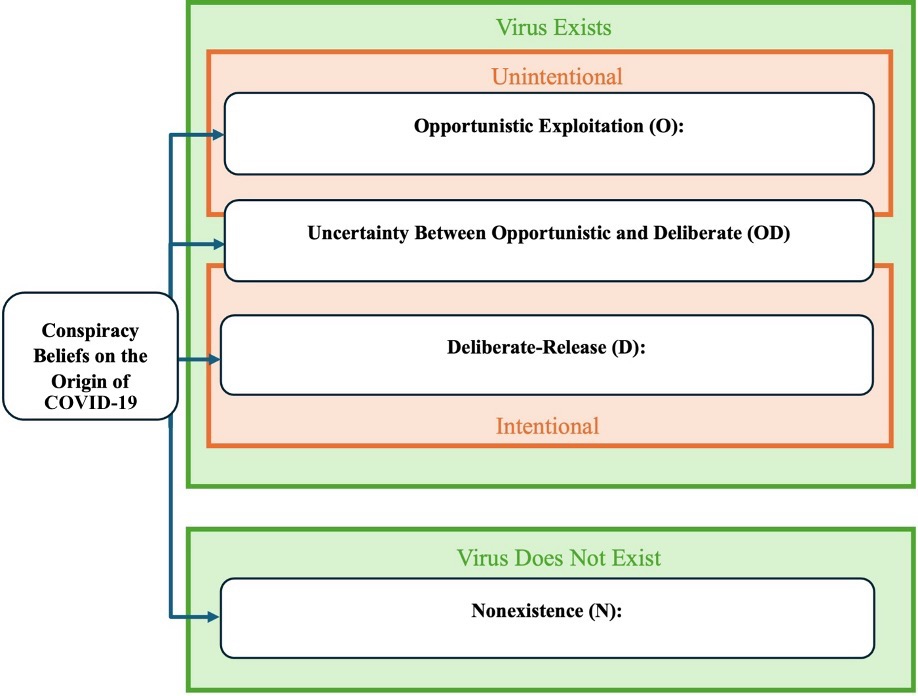
Figure 1. Mapping of COVID-19 Origin Conspiracy Beliefs and Layers of Incompatibility.
Source: Author’s own.
Table 1. Participants’ COVID-19 Origin Narratives.
|
Participant |
Code |
Summary of COVID-19 Conspiracy Narrative |
|
Mr. Kimura (October 2022) |
O |
The COVID-19 virus was accidentally leaked from a laboratory in Wuhan, China. Chinese authorities attempted to cover it up, but infections spread rapidly, producing the COVID-19 pandemic. Big Pharma, in collusion with world leaders, promoted masking and COVID-19 vaccination to profit from the pandemic. |
|
Mr. Katō (October 2022) |
D |
The COVID-19 virus was engineered in a laboratory in Wuhan, China, and deliberately released by a cabal of powerful elites to reduce the global population. Because the virus was ineffective, conspirators used scientists and researchers to convince the public that COVID-19 was dangerous. Japan was used as a testing ground for population-control vaccines due to what he described as the docile and submissive nature of the Japanese people. |
|
Ms. Matsuda (August 2023) |
OD |
The COVID-19 virus originated in a laboratory in Wuhan, China, but it is unclear whether it was deliberately released or accidentally leaked. After the COVID-19 pandemic began, the Chinese government exploited the crisis to expand its economic influence. Big Pharma, together with vested interests in the U.S. government, promoted insufficiently tested COVID-19 vaccines for profit. |
|
Ms. Shimada (August 2023) |
D |
The universe is controlled by malevolent cosmic forces that feed on human suffering. The COVID-19 virus was engineered and then deliberately released by individuals manipulated by these entities. Public health measures during the COVID-19 pandemic, including vaccination, masking, and social distancing, were designed to isolate people, weaken them, and increase suffering, thereby sustaining these cosmic forces. |
|
Mr. Tanaka (August 2023) |
D |
A powerful cabal ordered the deliberate release of the COVID-19 virus. As the virus evolved into a weaker form, conspirators used institutions such as the WHO and the UN to convince the public that COVID-19 remained dangerous, fostering fear and compliance. COVID-19 vaccines were administered to reduce the global population. The Japanese government, described as a puppet of the American Deep State, enforced these measures to keep the population sick, afraid, and easier to control. |
|
Ms. Suzuki (August 2023) |
OD |
It is unclear whether the COVID-19 virus was deliberately released or accidentally leaked. After the COVID-19 pandemic began, Big Pharma developed COVID-19 vaccines that were later discovered to be ineffective and harmful. Manufacturers concealed this information to continue selling COVID-19 vaccines for profit. |
|
Mr. Fujimoto (September 2023) |
N |
The COVID-19 virus does not exist; reported COVID-19 cases are fabricated or misclassified illnesses such as seasonal influenza. A global cabal orchestrated the COVID-19 pandemic as a hoax to expand control over the population. COVID-19 vaccines contain microscopic chips used for mind control. |
|
Ms. Iwayama (October 2023) |
D |
The COVID-19 virus was deliberately released to cause chaos and confusion. Most Japanese politicians are manipulated by conspirators, with only a few exceptions. Big Pharma, acting through the WHO, promoted dangerous COVID-19 vaccines to weaken the population. Further crises are planned to expand control in the future. |
|
Mr. Okudera (November 2023) |
O |
The COVID-19 virus was accidentally leaked from a laboratory in Wuhan, China, triggering the COVID-19 pandemic. Big Pharma and national governments exploited the crisis by promoting masking and COVID-19 vaccination for profit. High-ranking Japanese officials colluded with pharmaceutical companies to convince the public that these measures were necessary. |
|
Mr. Morimoto (March 2024) |
O |
The COVID-19 virus likely originated in a laboratory in Wuhan, China, where it was being developed as a bioweapon and was accidentally leaked. After the COVID-19 pandemic began, powerful elites exploited the crisis to introduce policies that expanded governmental and corporate control. COVID-19 vaccines were rushed primarily for profit. |
|
Ms. Kaneda (April 2024) |
D |
A secret shadow society deliberately released the COVID-19 virus. A small number of senior Japanese lawmakers belong to this group, while others are manipulated. The COVID-19 pandemic was planned to advance various objectives, primarily increasing control over global citizens. |
|
Mr. Takehashi (April 2024) |
D |
The Illuminati planned the COVID-19 pandemic by deliberately releasing the COVID-19 virus. They controlled online and mass media to convince the public that COVID-19 was dangerous. Lockdowns and social distancing trained people into compliance. Masks and COVID-19 vaccines were not only ineffective but intentionally harmful. |
|
Ms. Someya (May 2024) |
D |
A group of powerful elites, including the U.S. Deep State, planned the COVID-19 pandemic to instill fear and exert control. These actors have secretly influenced Japanese society since World War II. COVID-19 vaccines were developed to weaken the population and facilitate domination of the country. |
|
Mr. Kawagoe (May 2024) |
O |
The COVID-19 pandemic may have natural origins. However, once it began, powerful elites exploited the crisis to justify increased surveillance and control. Big Pharma and Big Tech exploited fear for profit. Conspirators will likely use future crises for further exploitation. |
|
Mr. Ichikawa (May 2024) |
N |
The COVID-19 virus does not exist; the COVID-19 pandemic was a deception orchestrated by a shadow society. Major media outlets and healthcare experts falsely claimed that the virus was real. The purpose of this deception was to control the population. |
Note. Narrative codes indicate each participant’s COVID-19 origin account: O = the outbreak began unintentionally, but conspirators later exploited it for political and/or economic gain; D = the pandemic was intentionally orchestrated (e.g., deliberate release of the virus by conspirators); OD = the participant withholds commitment between O and D (i.e., uncertain whether the outbreak was unintentional or intentional); N = the pandemic is a hoax and the virus does not exist. Participants are listed in order of interview.
Elaborate Narratives Beyond Generalised Distrust
A central premise of the contradictory-belief interpretation is that what believers endorse is the rejection of the official account rather than the contents of any specific narrative (Wood et al., 2012, p. 768). The accounts elicited in this study complicate that premise. Across interviews, most participants offered well-developed stories that named specific actors, motives, and causal steps (see Table 1). Participants typically went beyond origin claims, describing how powerful actors had capitalised on, orchestrated, or fabricated the pandemic. For example, Mr. Katō (D-type) gave a detailed account involving a vast network of conspirators who attempted to spread a deadly virus to reduce the global population. In his telling, this effort failed due to the virus’s limited effectiveness, leading conspirators to develop a ‘poisonous vaccine’ (Katō, field notes, October 2022), which they then promoted to achieve a similar effect while also profiting from it. During his interview, he also went into detail about the lab where the virus was allegedly engineered, the conspirators’ objectives for releasing the virus, and the different actors involved in the conspiracy (e.g., the American Deep State, the Chinese Communist Party (CCP), and the Rothschild family).
Participants also frequently presented specific details as evidence for their accounts and described how this evidence had shaped their beliefs. Ms. Someya (D-type), for example, based her account on claims she encountered on social media. She argued that the virus had been patented prior to the 2019 outbreak, citing what she presented as verifiable evidence: ‘There’s a patent on the virus by the World Health Organisation. You can check it online yourself. The patent was filed back in 2015. They’ve been planning this way before the start of the pandemic’ (Someya, interview, May 2024).
In short, participants were working with distinct, internally structured explanations. If contradictory endorsement is read as evidence that the details of any single account matter less than opposition to the official one (Wood et al., 2012, p. 768), then the elaboration highlighted here suggests a different baseline: participants were defending specific stories rather than merely registering distrust toward official narratives. This makes it possible to observe how they defended these accounts when contradictions were made explicit. The next section, therefore, examines how participants responded when confronted with incompatible alternatives.
‘I Don’t Agree’: Maintaining a Preferred Account
When presented with competing origin claims, 13 of the 15 participants worked to preserve a single preferred account. The pattern appeared across all three narrative types.
Mr. Okudera (O-type, interviewed in English) described how he eventually concluded that the virus must have been leaked by accident: ‘[During] the first couple of months [of the pandemic], I didn’t know what I should think about it. And after a few months, I believed someone had made a mistake, and they spread it by accident’ (Okudera, interview, November 2023). Asked what made him confident in this narrative, he anchored it in the proximity of the Wuhan laboratory: ‘There’s a lab not far from the wet market that was studying the novel coronavirus. I thought that’s where it must have come from’. Presented with deliberate-release and nonexistence claims, he did not treat them as equally plausible alternatives, but neither did he dismiss them: ‘I see people posting these things online. I don’t want to ignore what they’re saying, even though I don’t agree that what they’re saying is correct’.
Mr. Katō (D-type) preserved his account through a different means: a personal encounter. He recounted having once driven a passenger who claimed to work for the CCP and who showed an identification card as proof. According to Mr. Katō, the conversation turned to human experimentation, and the passenger told him that they were ‘experimenting with viruses’ and ‘developing [them] into weapons’ (Katō, field notes, October 2022). When asked about the possibility of an accidental lab leak, Mr. Katō rejected it unequivocally, stating that the outbreak was ‘definitely intentional’ (Katō, field notes, October 2022). He also affirmed that the virus itself was real but essentially harmless, citing his own case of COVID-19 a few months prior, which he said he had treated with ivermectin. Both his deliberate-release claim and his ‘real but harmless’ claim were grounded in personal experience, which he cited to reject alternative explanations.
Among the two N-type participants, Mr. Ichikawa and Mr. Fujimoto, narrative consistency operated in a different way. Because they began from the premise that the virus did not exist, other accounts could not stand as competing alternatives; they had to be reinterpreted as components of a broader COVID-19 hoax. Mr. Ichikawa, for example, argued that early infection counts were ‘made up’ or involved ‘relabeling flu cases’ (Ichikawa, field notes, May 2024). He then claimed that later illness and vaccine-related deaths were reattributed to a nonexistent virus to sustain the narrative.
Some O- and D-type participants raised similar points about malicious actors falsifying COVID-19-related data. Still, they used these claims to argue that authorities inflated infection and mortality rates, not that the virus was unreal. For the N-type participants, the key deception was the claim that the virus existed in the first place. In that frame, people who doubted authorities but still accepted the virus as real were not just mistaken. As Mr. Fujimoto put it, they were ‘still spreading the hoax’, which he described as being ‘manipulated’ by the conspirators (Fujimoto, interview, September 2023).
Maintaining a preferred account did not always involve outright dismissal. Some participants acknowledged alternative claims while keeping them outside their own beliefs.
‘Well, It Might Be Possible’: Acknowledging Without Endorsing
Participants sometimes acknowledged an alternative narrative as possible while declining to endorse it. Six of the 13 single-narrative participants showed this pattern: four D-type participants (two acknowledged O as possible; two acknowledged both O and N) and two of the four O-type participants (both acknowledged D). The two N-type participants did not. For those committed to the view that the virus does not exist, alternative origin accounts cannot be partially acknowledged without conceding the premise on which their entire narrative rests.
Mr. Tanaka, a nurse, described the nonexistence narrative as something he had encountered frequently online. He avoided outright dismissal of such claims, saying, ‘I can’t say it’s definitely not possible…’, before grounding his own view in professional experience: ‘…but I treat patients who have caught COVID-19 before, so I think it’s real’ (Tanaka, interview, August 2023). Mr. Tanaka recognised the claim’s possibility in principle but reaffirmed his preferred account on clinical grounds.
Ms. Shimada (D-type) gave a similar response when asked about an accidental lab leak. She did not rule it out as impossible but treated deliberate release as her central account: ‘Well, it might be possible… But, I think somebody way high up gave the order to release the virus’ (Shimada, interview, August 2023). Her concession extended only to the mechanism, not the meaning: a leak was conceivable, but the intentionality behind the outbreak, the element that organised her account, was not up for negotiation.
In a closed-ended survey, statements like these would appear as weak agreement with multiple items. In the interview context, however, they functioned differently; participants acknowledged competing claims without incorporating them into their own beliefs. This is precisely the distinction (endorsing a proposition as true versus entertaining it as a possibility) that closed-ended scales cannot register.
‘I Think Either Could Be Possible’: Withholding Commitment
Two participants, Ms. Matsuda and Ms. Suzuki, withheld commitment between the O and D accounts, treating both as possible without endorsing either, even after probing on their implications. I assigned OD in these cases.
Ms. Matsuda (interviewed in English) withheld commitment on intentionality while expressing confidence that the virus was likely human-engineered:
Where is it from? It’s hard to say… If you look at the protein spikes on the virus, it seems to be engineered. You don’t see that occurring naturally. Whether it was leaked on purpose or by accident, I really cannot say. I think either could be possible (Matsuda, interview, August 2023).
Asked about claims that the virus was completely fabricated, she rejected them: ‘I don’t think so. There is a lot of evidence that the virus is real’ (Matsuda, interview, August 2023).
Ms. Suzuki took a similar position. Asked whether the outbreak was accidental or intentional, she declined to commit: ‘I don’t really know, I won’t be surprised by either’ (Suzuki, interview, August 2023). When asked whether she leaned more toward O or D, she again declined to choose. At the same time, she rejected claims of nonexistence, citing friends and relatives who had contracted COVID-19 since the pandemic began.
Taken together, OD-type responses are best understood as reflecting withheld commitment between O and D, paired with a clear rejection of the N narrative. Consider how this stance might translate into survey form: on a 7-point Likert item of the kind Wood et al. (2012) used, Ms. Matsuda might ‘somewhat agree’ with both ‘the virus was deliberately released’ and ‘the virus was accidentally leaked’; equally plausibly, she might select the neutral midpoint, ‘neither agree nor disagree’. Neither response would adequately capture her actual stance. The first option would aggregate across items as co-endorsement of mutually exclusive claims, the very pattern cited as evidence of contradictory belief (see the contradictory-belief literature reviewed above). In the interview, by contrast, the same stance reads as withheld commitment between two not-yet-foreclosed possibilities. What appears in survey data as inconsistent agreement may, under open-ended probing, instead reflect a refusal to choose between incompatible accounts rather than simultaneous belief in both.
‘COVID-19 Is a Farce’: Shared Labels with Divergent Claims
Across interviews, participants drew on a shared vocabulary that circulated in conspiratorial spaces. Common terms included chaban (‘farce’ or ‘staged drama’), mezameru (‘awaken’), koronanō (‘COVID-19 brain’), and masugomi (a portmanteau of ‘mass media’ and ‘trash’). While this vocabulary was shared, participants often attached personal interpretations to these terms. The term chaban is a particularly revealing case. Chaban was not linked to a single origin narrative. Instead, it served as a shorthand for the claim that the pandemic was a farce (i.e., that authorities were putting on a play), while how and why it was farcical varied across participants. The three examples below illustrate this point. Although the speakers held three distinct origin narratives (O-type, D-type, and N-type), all three referred to COVID-19 as a chaban when discussing their beliefs.
Mr. Kimura (O-type) used chaban to criticise how he felt mainstream media framed the pandemic, describing how it ‘pushed the COVID-19 chaban’ to keep the public afraid (Kimura, field notes, October 2022).
Ms. Kaneda (D-type) also used the term: ‘I sometimes read newspapers, but only to laugh at the politicians playing along with the [COVID-19] chaban’ (Kaneda, interview, April 2024).
Mr. Fujimoto (N-type) likewise referred to the pandemic as a chaban while describing efforts to mezamesaseru (‘awaken’) others: ‘I have tried to awaken a few of my close friends to the truth, but some of them are still convinced by the COVID-19 chaban’ (Fujimoto, interview, September 2023).
The dynamic appeared in a different form with mezameru. Unlike chaban, which traveled across all three narrative types, mezameru appeared more selectively, primarily among participants whose accounts alleged deliberate orchestration or fabrication (i.e., D-type and N-type). Among those who did use it, however, the same pattern held: participants described themselves as having ‘awakened’, but the content of that awakening varied with their underlying account. For D-type participants, it marked recognition of a deliberate plot to release the virus. For N-type participants, it signaled awakening to the deception that the pandemic itself was real. The two examples below illustrate this divergence.
Mr. Tanaka (D-type) traced his mezameru moment to a change of workplace:
I liked listening to things like conspiracy theories, but I didn’t really research on my own or believe in them much. When I turned 25, however, I changed jobs to my current [nursing] company. Since then, my current company has been very sensitive and quick to provide information regarding jobs and health. Listening to them and researching on my own made me realise that something is off, and everything seemed connected. That’s how I mezameta (‘awakened’) (Tanaka, interview, August 2023).
Mr. Ichikawa (N-type) described having been attuned to authorities’ manipulation before the pandemic, and said that the mass panic and the government’s enforcement of measures such as school shutdowns and restrictions on commuting and travel prompted him to investigate further. He attributed his ‘awakening’ to that period, noting that he was able to ‘mezameru thanks to the COVID-19 chaban’ (Ichikawa, field notes, May 2024).
That O-type participants in this sample did not adopt mezameru is consistent with the term’s stronger identity claim: rather than naming a specific deception, it positions the speaker as having seen through a larger illusion, a stance more easily occupied by participants who believe the pandemic was deliberately orchestrated or fabricated than by those who treat it as a real event that was opportunistically exploited.
Together, these examples show that shared language can obscure real disagreement, though not always in the same way. Chaban traveled across all three narrative positions, with each speaker incorporating the term within their own account. Mezameru clustered more selectively among participants whose accounts alleged deliberate orchestration or fabrication, but produced the same kind of divergence among those who used it. In both cases, apparent agreement on shared vocabulary can signal a common stance of distrust toward the official account while obscuring substantive disagreement about exactly what is being claimed.
Summary: Coherent Narratives Under Probing
Across the sample, mutually exclusive COVID-19 origin narratives were rarely treated as jointly true. Once meanings and commitments were clarified through targeted probing, participants typically maintained coherence by endorsing a single narrative and rejecting incompatible alternatives. In some cases, participants acknowledged a competing claim as conceivable without endorsing it. In a smaller subset of cases (OD), participants withheld commitment between O and D rather than simultaneously endorsing both.
At the first layer of incompatibility (whether the virus was intentionally spread), most participants converged on a single narrative, while OD-type participants remained noncommittal, treating intentionality as unresolved rather than expressing belief in both accounts. At the second layer (whether the virus exists at all), N-type participants anchored coherence in denying the virus’s existence and reinterpreted competing origin accounts as components of a broader deception.
A further pattern concerned shared conspiratorial vocabulary. Participants frequently used terms such as chaban, but these labels functioned as interpretive shorthand rather than as a shared proposition. While chaban signaled distrust toward official accounts, it masked meaningful differences in participants’ beliefs about whether the virus was opportunistically exploited, deliberately released, or entirely fabricated.
Discussion
Reassessing Contradiction Among Believers
This study offers new insight into a widely accepted but increasingly contested claim in the conspiracy theory literature: that believers often endorse mutually contradictory narratives about the same event (Wood et al., 2012). While survey-based research has documented positive correlations between endorsing logically incompatible items, critics have questioned whether these patterns reflect simultaneous belief in contradictions or whether they are measurement effects that may obscure how people reason through competing claims (Lukić et al., 2019; van Prooijen et al., 2023). Others attribute co-endorsement to a stable disposition to hold incompatible beliefs (Petrović and Žeželj, 2023, 2025).
The present study contributes to this reassessment by examining the population on which the survey evidence is thinnest: committed believers. Specifically, it examines how Japanese believers engaged with three mutually exclusive COVID-19 origin narratives: O, D, and N. Of the 15 participants, four endorsed the O narrative, seven endorsed D, and two endorsed N. The remaining two (OD) withheld commitment between O and D while still rejecting N. Within this sample, I did not observe clear examples of simultaneous endorsement of mutually exclusive propositions when participants were asked about alternative narratives. Most accounts were instead organised around a single narrative, which most participants articulated in detail. Even the OD profile, which most resembles co-endorsement in survey terms, took the form of withheld commitment rather than simultaneous belief.
This pattern qualifies interpretations that treat co-endorsement as direct evidence of contradictory belief. If participants held contradictory beliefs in the strict sense, one would expect them to state within the same account that the virus both existed and did not exist, or that it was both intentionally released and had unintentionally emerged. Instead, probing incompatible alternatives did not lead participants to accept them. Participants tended to articulate one position, justify it, and treat alternatives as incorrect or implausible. Survey co-endorsement can also reflect weaker epistemic stances, including general uncertainty or openness to multiple possibilities. Noncommitment represents a more specific case, in which participants explicitly recognise an incompatibility and withhold commitment between competing propositions. OD participants treated O and D as competing possibilities rather than endorsing both as true, a stance that could be misinterpreted as co-endorsement in survey items.
These findings differ from those of Petrović and Žeželj (2025), whose respondents maintained contradictory beliefs even when prompted to cross-reference their own inconsistent answers. However, the two studies observed different populations under different conditions. Their respondents were drawn from the general population and confronted with inconsistencies registered on closed-ended items; participants in this study were committed believers who articulated preferred accounts in their own terms before facing incompatible alternatives. Whether contradiction persists may therefore depend on where it originates: in the instrument’s item pairs or in the believer’s own narrative. Applying their cross-referencing procedure to committed believers, rather than general-population samples, would test this directly.
A second observation concerns how participants maintained coherence. Across the sample, preferred accounts were typically grounded in specific evidentiary anchors, frequently including personal experience. Mr. Katō grounded his deliberate-release account in an alleged personal encounter with a CCP official, and his ‘real but harmless’ claim in his own recovery from COVID-19. Ms. Suzuki rejected nonexistence claims on the basis of personal contact with infected individuals, and Mr. Tanaka, while acknowledging the nonexistence claim as possible in principle, anchored the virus’s reality in his clinical work. Such grounding may help explain why participants treated alternative claims as incorrect or implausible rather than as candidates for acceptance. Generalised distrust of official accounts coexists, in these interviews, with concrete evidentiary commitments that participants were unwilling to set aside even under probing.
Disputing Claims Within the Conspiracy Milieu
Beyond variation in origin narratives and understanding of shared terminology, the interviews also revealed how believers distinguished themselves from other believers who subscribed to a different narrative. This pattern was most clearly expressed by the two N-type participants, who framed other believers as partially awakened yet still misled. These instances suggest that shared distrust of official accounts does not, by itself, produce a unified belief system organised around a single conspiratorial worldview. Instead, conspiracy belief was marked by internal differentiation and ongoing negotiation over which claims, and which believers, were credible.
This finding shifts attention from a simple believer-versus-non-believer divide to credibility disputes within conspiratorial milieus. Some participants did not merely reject official accounts; they also evaluated competing conspiratorial accounts and positioned themselves as more informed or reasonable than other believers. Similar dynamics have been documented ethnographically in the Dutch conspiracy milieu, where participants differentiate themselves from fellow believers and deflect the ‘conspiracy theorist’ label onto them (Harambam and Aupers, 2017). The present findings suggest the same contestation operates in the Japanese milieu, visible here along the lines of incompatible origin narratives. In that sense, conspiracy belief is not only a stance against official accounts and those who uphold them but also a field of contestation in which epistemic authority is claimed and disputed.
Methodological Implications
A central implication is that some of the perceived incoherence in conspiracy beliefs may reflect how beliefs are measured. Closed-ended survey formats reduce complex judgments to agreement scales on pre-formulated items. When respondents select ‘agree’ or ‘somewhat agree’ across multiple conspiracy items, it is often unclear whether they are committing to the full propositional content of each claim, registering it as plausible without endorsing it, or expressing a broader distrust of official accounts. What appears as weak agreement in surveys may instead reflect the boundary-drawing that interviews can detect but closed-ended items typically obscure.
In-depth interviews, by contrast, allowed participants to articulate their views in context and to distinguish among competing narratives. Rather than inferring contradiction from item correlations, this study elicited preferred accounts in participants’ own terms and then introduced explicitly incompatible alternatives to observe how participants handled them. These findings emerge from that design: making competing narratives explicit allows firm endorsement to be distinguished from acknowledging plausibility, and from entertaining possibilities while withholding commitment. Standard agreement scales can easily conflate these response types.
These findings suggest practical refinements for future surveys measuring contradictory beliefs. One approach is to separate plausibility from belief by asking first how plausible a narrative seems and second whether the respondent believes it to be true (see also Lukić et al., 2019, p. 104). In Wood et al.’s (2012) second study, for instance, ‘endorsement’ was itself a composite that averaged ratings of plausibility and worth considering into a single score; the two judgments cannot be separated in such a measure. A related refinement is to avoid treating ‘somewhat agree’ as simply a weaker endorsement. Partial agreement can reflect uncertainty or acknowledgment without endorsement (e.g., ‘it’s possible, but…’) rather than commitment to the claim. One practical step is to add a brief follow-up for ‘somewhat agree’ responses that distinguishes commitment from noncommitment (e.g., weak endorsement or treating it as merely a possibility).
A second set of refinements concerns mutual exclusivity. Instead of inferring contradiction from correlations between separate items, instruments can incorporate direct exclusivity checks. For example, if a respondent rates both a murder account and a faked-death account of Princess Diana’s death as plausible (the type of contradictory pair examined by Wood et al., 2012), a follow-up can ask whether both can be true at the same time, whether only one can be true, or whether the respondent cannot decide. Such designs better distinguish between contradiction and noncommitment under uncertainty and reduce the risk of interpreting co-endorsement correlations as direct evidence of contradictory beliefs.
Finally, the study clarifies that contradiction is not the only measurement concern. A shared distrust of official accounts was pervasive across all narrative positions, but it did not map neatly onto a single conspiratorial narrative, in part because participants used shared terms with different underlying meanings, as the chaban finding showed. The caution for survey measurement is that items gauging belief should be specific enough to identify which conspiracy theory a respondent endorses. A statement such as ‘COVID-19 is a farce’, for example, could mean that a real outbreak was exploited, that an engineered virus was deliberately released, or that the pandemic never happened at all. Without this specificity, item-level agreement risks aggregating across substantively distinct beliefs.
Measuring Conspiracy Belief in Japan
These findings also speak to the growing Japanese survey literature reviewed above. That literature measures belief across varied theories rather than competing narratives about a single event, and much of this study’s typology is specific to the latter. One problem, however, is shared: on a closed-ended rating item, endorsing a claim as true and acknowledging it as merely plausible can produce the same answer. Sato et al.’s (2024) 24.4% estimate, for example, counts ‘somewhat agree’ responses as belief, and Cheng’s (2024) 18.9% ‘Believers’ cluster spans what he describes as belief ‘to varying degrees’; both therefore blend firm commitment and mere acknowledgment. The same specificity concern applies to milieu vocabulary: agreement with a broad item built around a shared term like chaban would register O-type, D-type, and N-type participants together while masking the incompatible narratives beneath their shared distrust. Neither concern is unique to Japan. However, because Japanese-language instruments are still being developed (Majima, 2024), the field is well placed to address both from the outset: item wording that distinguishes such narratives and response formats that separate plausibility from belief would make the resulting estimates more interpretable.
Limitations and Interview Effects
A potential challenge to these conclusions is that participants may have emphasised coherence as a form of impression management during interviews. Face-to-face interaction with an academic researcher could encourage participants to present their beliefs more systematically to appear rational, and social desirability bias might lead them to avoid explicitly endorsing illogical beliefs. My own positionality likely shaped this dynamic. My affiliation with a public university, which created barriers in initial recruitment as noted earlier, was visible to participants throughout the interviews and may have influenced how they framed their views, particularly around questions of legitimacy, credibility, and what they assumed I would find believable.
However, this concern cuts in two directions. The interviews did not simply record unprompted narratives; after participants articulated their preferred account, I introduced explicitly incompatible alternatives and asked them to respond to each. Under these conditions, participants generally handled incompatibilities by rejecting or avoiding commitment rather than asserting that both incompatible propositions were true at once. This pattern does not rule out the possibility that interview accountability encouraged coherence. Nevertheless, it suggests that a strong dispositional reading of survey-based co-endorsement (namely, that believers straightforwardly accept mutually exclusive propositions as jointly true; cf. Petrović and Žeželj, 2023, 2025) may not generalise to contexts in which incompatibilities are made explicit and participants are asked to reason through them. And even if coherence was partly produced by the interview interaction itself, that remains substantively informative: it shows how believers justify their accounts, draw epistemic boundaries, and manage uncertainty when explaining their views to others.
A further limitation concerns sample size. With 15 participants in total and subgroup sizes as small as two (for both N-type and OD-type), patterns observed within smaller subgroups should be treated as suggestive rather than conclusive. This applies particularly to the absence of mezameru used among O-type participants and the structural unavailability of ‘acknowledgment without endorsement’ among N-type participants. The broader analytical claims about narrative coherence are supported across the full sample, but firmer claims about subgroup-specific patterns would require larger samples.
Conclusion
This study revisited the claim that conspiracy theory believers endorse mutually contradictory conspiracy theories because their distrust of the official account overrides logical consistency (Wood et al., 2012). Using interviews with 15 Japanese conspiracy theory believers (October 2022–May 2024), I combined open-ended elicitation of preferred COVID-19 origin accounts with targeted probing that introduced explicitly incompatible alternatives. This design made it possible to evaluate contradiction at the points where it should be most visible: the two layers of incompatibility separating the narratives (whether the virus was intentionally spread, and whether it exists at all).
The dominant pattern was not contradiction but coherence around a single narrative. Participants generally endorsed one account and rejected incompatible alternatives, occasionally acknowledging a competing claim as plausible without endorsing it. The OD profile, the closest analogue to what surveys might capture as co-endorsement, took the form of withheld commitment between the O and D narratives rather than strong endorsement of both. At the existence layer, some participants who believed the virus was real acknowledged the possibility that it was fabricated without endorsing it. By contrast, participants who denied the virus’s existence reinterpreted competing origin narratives as part of a broader deception. Participants also articulated detailed causal accounts, indicating selectivity rather than indiscriminate endorsement of competing claims.
Taken together, these results show that survey-based co-endorsement can overstate the presence of contradictory beliefs when incompatibilities are not made explicit. In this study, participants rarely treated mutually exclusive accounts as jointly true. Instead, they maintained coherence by rejecting alternatives, acknowledging them as plausible without endorsing them, or withholding commitment between competing narratives while still drawing boundaries around what counted as true. Beyond this central finding, the study offers two further contributions. Empirically, it extends the debate over contradictory beliefs to Japan by mapping how a small set of believers organised COVID-19 origin narratives and evaluated competing conspiratorial claims. Methodologically, it highlights measurement refinements for surveys, including separating belief from perceived plausibility, treating partial agreement as potentially noncommittal, and incorporating direct exclusivity checks rather than inferring contradiction from item correlations alone. More broadly, the findings support recent skepticism toward the contradictory-belief interpretation (Lukić et al., 2019; van Prooijen et al., 2023), and they qualify dispositional accounts of doublethink (Petrović and Žeželj, 2023, 2025) by drawing evidence from the population those accounts have yet to observe directly: committed believers reasoning through incompatibilities in their own terms.
Future work could test these measurement refinements at scale, extend the elicit-then-probe interview design to other conspiratorial domains and national contexts, or examine longitudinally how believers maintain coherence as informational environments shift. In the meantime, strong claims about contradictory beliefs should not be inferred from co-endorsement patterns without attention to what respondents mean, what they commit to, and how they reason through explicit incompatibilities.
References
Bruder, M., Haffke, P., Neave, N., Nouripanah, N. and Imhoff, R. (2013) ‘Measuring individual differences in generic beliefs in conspiracy theories across cultures: Conspiracy Mentality Questionnaire’, Frontiers in Psychology, 4, 225. https://doi.org/10.3389/fpsyg.2013.00225
Cheng, J.W. (2024) ‘Gendai Nihon ni okeru inbō-ron to sono shinja-zō’ [Conspiracy theories in contemporary Japan and the profiles of believers], Goethe-Institut Japan. Available at: https://www.goethe.de/ins/jp/ja/kul/dis/fac/ctj.html (Accessed: 10 May 2026).
Demelius, Y. and Szczepanska, K. (2024) ‘Conspiracy theories and the COVID-19 pandemic in Japan: The rise, radicalization, and fall (?) of YamatoQ-kai’, Social Science Japan Journal, 27, 2, pp. 149–168. https://doi.org/10.1093/ssjj/jyae003
Franks, B., Bangerter, A., Bauer, M.W., Hall, M. and Noort, M.C. (2017) ‘Beyond “monologicality”? Exploring conspiracist worldviews’, Frontiers in Psychology, 8, 861. https://doi.org/10.3389/fpsyg.2017.00861
Fujiwara, G. (2022) Q o ou: Inbōron shūdan no shōtai [Chasing Q: The true identity of a conspiracy-theory group]. Tokyo: Asahi Shimbun Shuppan.
Goertzel, T. (1994) ‘Belief in conspiracy theories’, Political Psychology, 15, 4, pp. 731–742. https://doi.org/10.2307/3791630
Harambam, J. and Aupers, S. (2017) ‘“I am not a conspiracy theorist”: Relational identifications in the Dutch conspiracy milieu’, Cultural Sociology, 11, 1, pp. 113–129. https://doi.org/10.1177/1749975516661959
Hartman, T., Marshall, M., Stocks, T., McKay, R., Bennett, K., Butter, S., Gibson-Miller, J., Hyland, P., Levita, L., Martinez, A., Mason, L., McBride, O., Murphy, J., Shevlin, M., Vallières, F. and Bentall, R. (2021) ‘Different conspiracy theories have different psychological and social determinants: Comparison of three theories about the origins of the COVID-19 virus in a representative sample of the UK population’, Frontiers in Political Science, 3, 642510). https://doi.org/10.3389/fpos.2021.642510
Hata, M. (2022) Inbōron: Minshushugi o yurugasu mekanizumu [Conspiracy theories: The mechanism that shakes democracy]. Tokyo: Chūō Kōron Shinsha.
Hornsey, M.J. and Pearson, S. (2022) ‘Cross-national differences in willingness to believe conspiracy theories’, Current Opinion in Psychology, 47, 101391. https://doi.org/10.1016/j.copsyc.2022.101391
Imhoff, R. and Lamberty, P. (2020) ‘A bioweapon or a hoax? The link between distinct conspiracy beliefs about the coronavirus disease (COVID-19) outbreak and pandemic behaviour’, Social Psychological and Personality Science, 11, 8, pp. 1110–1118. https://doi.org/10.1177/1948550620934692
Japan Federation of Democratic Medical Institutions (2023) ‘Statement on reclassification of Covid-19 under Infectious Diseases Control Law’, 14 April. Available at: https://www.min-iren.gr.jp/english/20230414_47616.html (Accessed: 12 December 2025).
Kearney, M.D., Chiang, S.C. and Massey, P.M. (2020) ‘The Twitter origins and evolution of the COVID-19 “plandemic” conspiracy theory’, Harvard Kennedy School Misinformation Review, 1, 3. https://doi.org/10.37016/mr-2020-42
Kelly, T. and Geddie, J. (2025) ‘YouTube generation propels Japan’s anti-foreigner politics into the mainstream’, Reuters, 25 July. Available at: https://www.reuters.com/world/youtube-generation-propels-japans-anti-foreigner-politics-into-mainstream-2025-07-25/ (Accessed: 15 December 2025).
Komesaroff, P.A. and Dwyer, D.E. (2023) ‘The question of the origins of COVID-19 and the ends of science’, Journal of Bioethical Inquiry, 20, 4, pp. 575–583. https://doi.org/10.1007/s11673-023-10303-1
Kubota, Y. (2025) ‘Dai 13-kai han-dīpusutēto dantai “Yamato-kyū” no daihyō ni atte kimashita (zenpen)’ [13th installment: I met the representative of the anti-deep state group ‘Yamato-Q’ (Part 1)], WEB Hon no Zasshi, 17 November. Available at: https://www.webdoku.jp/column/kubota/2025/1117_124053.html (Accessed: 15 December 2025).
Lewandowsky, S. and Cook, J. (2020) The conspiracy theory handbook. George Mason University. Available at: https://research-information.bris.ac.uk/ws/portalfiles/portal/240357194/ConspiracyTheoryHandbook.pdf (Accessed: 25 October 2025).
Lukić, P., Žeželj, I. and Stanković, B. (2019) ‘How (ir)rational is it to believe in contradictory conspiracy theories?’, Europe’s Journal of Psychology, 15, 1, pp. 94–107. https://doi.org/10.5964/ejop.v15i1.1690
Majima, Y. (2024) ‘Nihongo-ban inbōron-teki shinsei shitsumonhyō no kaihatsu to datōsei no kentō’ [Development and validation of the Japanese version of the Conspiracy Mentality Questionnaire], Shakai Shinrigaku Kenkyū (Japanese Journal of Social Psychology), 40, 1, pp. 35–45. https://doi.org/10.14966/jssp.2023-012
Marcantuoni, R. and Fahey, R.A. (2025) ‘Fighting the cabal from the Diet: Sanseitō and the role of conspiracy as political ideology’, The Asia-Pacific Journal: Japan Focus, 23, 10, e14. https://apjjf.org/2025/10/marcantuoni-fahey
Miller, J.M. (2020) ‘Psychological, political, and situational factors combine to boost COVID-19 conspiracy theory beliefs’, Canadian Journal of Political Science, 53, 2, pp. 327–334. https://doi.org/10.1017/S000842392000058X
Nawata, K., Oga, T. and Fujimura, M. (2023) ‘COVID-19 ni kansuru inbō shinnen ga motarasu kansen bōshi seisaku no hitei to kansen risuku kōdō: Kansen risuku keishi no baikai-teki eikyō’ [Conspiracy beliefs about COVID-19 leading to riskier behaviour and disapproval of national infection prevention policies: The mediating effects of a disregard for infection risk], JikkenShakai Shinrigaku Kenkyū (Japanese Journal of Experimental Social Psychology), 62, 2, pp. 182–194. https://doi.org/10.2130/jjesp.si5-4
Petrović, M.B. and Žeželj, I. (2023) ‘Both a bioweapon and a hoax: The curious case of contradictory conspiracy theories about COVID-19’, Thinking & Reasoning, 29, 4, pp. 456–487. https://doi.org/10.1080/13546783.2022.2088618
Petrović, M.B. and Žeželj, I. (2025) ‘Inconsistent yet unyielding: Persistence of contradictory beliefs and strategies for their reconciliation’, British Journal of Psychology, 116, 4, pp. 1050–1075. https://doi.org/10.1111/bjop.70002
Reuters (2020) ‘Fact check: The virus that causes COVID-19 exists, can be tested for and is not the flu’, Reuters, 11 September. Available at: https://www.reuters.com/article/world/fact-check-the-virus-that-causes-covid-19-exists-can-be-tested-for-and-is-not-the-flu-idUSKBN2613BL/ (Accessed: 8 November 2025).
Reuters (2021) ‘Japanese Trump supporters rally in Tokyo ahead of Biden’s inauguration’, Reuters, 20 January. Available at: https://www.reuters.com/article/us-usa-biden-japan-rally/japanese-trump-supporters-rally-in-tokyo-ahead-of-bidens-inauguration-idUSKBN29P1J1/ (Accessed: 8 November 2025).
Sato, Y., Kawachi, I., Saijo, Y., Yoshioka, E., Osaka, K. and Tabuchi, T. (2024) ‘Correlates of COVID-19 conspiracy theory beliefs in Japan: A cross-sectional study of 28,175 residents’, PLOS ONE, 19, 12, e0310673. https://doi.org/10.1371/journal.pone.0310673
Sutton, R.M. and Douglas, K.M. (2020) ‘Conspiracy theories and the conspiracy mindset: Implications for political ideology’, Current Opinion in Behavioural Sciences, 34, pp. 118–122. https://doi.org/10.1016/j.cobeha.2020.02.015
Swami, V., Coles, R., Stieger, S., Pietschnig, J., Furnham, A., Rehim, S. and Voracek, M. (2011) ‘Conspiracist ideation in Britain and Austria: Evidence of a monological belief system and associations between individual psychological differences and real-world and fictitious conspiracy theories’, British Journal of Psychology, 102, 3, pp. 443–463. https://doi.org/10.1111/j.2044-8295.2010.02004.x
Toriumi, F., Sakaki, T., Kobayashi, T. and Yoshida, M. (2024) ‘Anti-vaccine rabbit hole leads to political representation: The case of Twitter in Japan’, Journal of Computational Social Science, 7, 1, pp. 405–423. https://doi.org/10.1007/s42001-023-00241-8
Tsuji, R. (2007) ‘Ōbei no inbōron no Nihon ni okeru juyō to henyō’ [The reception and transformation of Western conspiracy theories in Japan], Shūkyō Kenkyū (Journal of Religious Studies), 80, 4, pp. 1222–1223. https://doi.org/10.20716/rsjars.80.4_1222
Tsuji, R. (2018) ‘The role of conspiracy theory in the Aum Shinrikyo incident’, in Dyrendal, A., Robertson, D.G. and Asprem, E. (eds.) Handbook of conspiracy theory and contemporary religion. Leiden: Brill, pp. 389–406. https://doi.org/10.1163/9789004382022_019
Uscinski, J.E. (2020) Conspiracy theories: A primer. Illustrated edn. Lanham, MD: Rowman & Littlefield.
van Prooijen, J.-W. and Douglas, K.M. (2017) ‘Conspiracy theories as part of history: The role of societal crisis situations’, Memory Studies, 10, 3, pp. 323–333. https://doi.org/10.1177/1750698017701615
van Prooijen, J.-W. and Douglas, K.M. (2018) ‘Belief in conspiracy theories: Basic principles of an emerging research domain’, European Journal of Social Psychology, 48, 7, pp. 897–908. https://doi.org/10.1002/ejsp.2530
van Prooijen, J.-W., Wahring, I., Mausolf, L., Mulas, N. and Shwan, S. (2023) ‘Just dead, not alive: Reconsidering belief in contradictory conspiracy theories’, Psychological Science, 34, 6, pp. 670–682. https://doi.org/10.1177/09567976231158570
Wood, M.J., Douglas, K.M. and Sutton, R.M. (2012) ‘Dead and alive: Beliefs in contradictory conspiracy theories’, Social Psychological and Personality Science, 3, 6, pp. 767–773. https://doi.org/10.1177/1948550611434786
Article copyright Zen Raphael Seltman.




The electronic journal of contemporary japanese studies was founded on 9 January 2001.
Page created 23 April 2026, last modified 23 April 2026.
Email the webmaster if you have any problems.
Copyright electronic journal of contemporary japanese studies.


