Nihonjinron Discourse and English Language Learning Attitudes: Unimpeded Perspectives Among Japanese High School Students
Volume 26, Issue 1 (Article 4 in 2026). First published in ejcjs on 23 April 2026.
Abstract
This study explores the extent to which Nihonjinron discourses influence Japanese high school students’ perceptions of national identity and English language learning. The study participants (N = 34) were second-grade Japanese high school students (16-17 years old) enrolled in a specialised English programme at a private high school in Sapporo, Japan. Drawing on data from a mixed-methods questionnaire, the research identifies key themes in students’ beliefs about Japanese culture, identity, and the role of English in intercultural communication. While many participants endorsed ideas consistent with Nihonjinron such as the uniqueness of Japanese culture and language, their attitudes toward English learning were largely open and pragmatic, and expressed strong interest in intercultural engagement. Furthermore, student conceptions of Japaneseness were based on behavioural values (e.g., cooperation, modesty, conformity) rather than ethnicity or race. In explaining how national identity is interpreted and negotiated, the findings suggest that students' perspectives may align more with 'transculturation' that celebrates cultural variation, rather than the 'Japanisation' goal of distinguishing 'us' from 'them’. The study contributes to contemporary understandings of identity formation in Japan and highlights the evolving and contested nature of Japanese identity discourses.
Keywords: Japanese identity, Nihonjinron, language learning, intercultural communication, English education, youth discourse, Japan.
Introduction
Identity is a fundamental construct in the field of language learning (Darwin & Sun, 2024). Nihonjinron, theories on Japanese people, are texts and rhetoric that stress Japanese cultural uniqueness (Seilhamer, 2013), found in academic discourse and all forms of Japanese mass media, and remain a prevalent narrative to this day (Manabe & Befu, 1993; Shah, 2024). Nihonjinron is a “pervasive ideology in which the Japanese are assigned enduring uniqueness, especially in comparison to the Western world” (Kinginger, 2009, p. 175). Poststructuralist perspectives on identity resist essentialist notions of culture such as Nihonjinron (Sugimoto, 1999), instead seeing identity as key to understanding intercultural communication (Darwin & Sun, 2024). Holding views consistent with Nihonjinron has been shown negatively to impact foreign language learning (Hinenoya & Gatbonton, 2000; Rivers, 2011), though studies concerning Japanese identity in English learning remain under-researched (Sullivan & Schatz, 2009). Drawing on over two decades of language teaching experience in Japan, the researcher has frequently encountered views that reflect Nihonjinron-related beliefs, including the participants in the current study. Common sentiments include claims such as ‘Japanese students can never master English’, and ‘we do not need English because this is Japan’. These observations formed the rationale for an inquiry into how cultural dichotomies such as Nihonjinron might impact language learners. The present study investigates the extent to which Nihonjinron discourse affects Japanese high school students’ attitudes to learning English. The following research question is considered:
To what extent are Japanese high school students’ beliefs about national identity and attitudes towards learning English shaped by the tenets of Nihonjinron discourse?
A literature review will consider the history and beliefs of Nihonjinron discourse, before exploring its effects on language learning. The findings of a questionnaire completed by Japanese high school students, as outlined in the Methodology section, will then be presented. Finally, the findings will be discussed to conclude what, if any, effects Nihonjinron discourse has on the study participants’ attitudes regarding identity and their English studies.
Nihonjinron
History
Discourse on Japanese uniqueness were propagated in Japan for centuries, though became a popular topic during the Meiji Period (1868-1912) when Japan opened up to the West (Kubota, 1999). According to Kawai (2015), the intellectual foundations of Nihonjinron discourse are deeply rooted in European and Western concepts of race and nation based on the work of Enlightenment thinkers who promoted the objective classification of people based on physical characteristics and cultural products. The core Japanese concepts of jinshu (race) and minzoku, (people/ethnic nation) were constructed by intertwining Western notions of race, nation, Volk, and ethnicity that integrated the ‘scientific’ thinking of Social Darwinism and eugenics (Kawai, 2015). The influential racial typology of Johann Friedrich Blumenbach frequently appeared in Japanese school textbooks until the 1920s, popularised by the leading Japanese intellectual Fukuzawa Yukichi (Kawai, 2015). Before the Second World War, the concept of minzoku fueled an ideology of Japanese ethnic superiority that was used to justify Japan’s colonial polices in Korea and China, as well as military campaigns in South-east Asia during the war (Kawai, 2015; Sugimoto, 1999).
Post-war, Nihonjinron continued this relationship by constructing Japanese identity largely through the appropriation and application of Western Orientalist ideas to Japan (Kawai, 2015). American anthropologist Ruth Benedict’s 1946 work, The Chrysanthemum and the Sword, strongly influenced this discourse by defining Japanese culture as collectivistic and hierarchical, contrasting it with the perceived individualistic West (Kawai, 2015). In the post-war years Nihonjinron emerged conceptually to fill the vacuum created by the nominal absence of terms like minzoku in Japanese identity and support the notion of Japan’s ethnic independence in standing up to American military occupation and influences of the ‘imperialist West’ (Kawai, 2015; Sugimoto, 1999). Nihonjinron gained mainstream cultural popularity in the 1960s and 1970s as Japan experienced rapid industrialisation and economic growth, accompanied by Westernisation (Kubota, 1999). This era saw prolific publications. Of the roughly 700 titles published on Japanese identity between 1946 and 1978, 25% were published between 1976 and 1978 (Wierzbicka, 1997). Influential works included Nakane Chie’s Tateshakai no ningen kankei (1967), Doi Takeo’s Amae no kōzō (1971), and Ezra Vogel’s Japan as Number One (1979) (Kawai, 2015). Nihonjinron writers affirmed characteristics such as collectivism, vertical social structure (tate shakai), homogeneity, and mutual psychological dependence (amae) as markers of Japanese uniqueness. According to Kubota (1999), Nihonjinron was used by Japanese and Western scholars to explain Japan’s economic miracle due to “unique interpersonal relationships, group psychology, social behaviors, lifestyles, language use, business management, and even biological brain functions” found in Japan and its people (p. 20). In the 1980s and 1990s Nihonjinron was appropriated by political, business, and opinion leaders to strengthen a Japanese identity they felt was under-threat by the forces of globalisation (Kubota, 2003). During this time the Japanese government accepted Nihonjinron as a valid description of Japanese society and sanctioned ‘cultural engineering’ as an important ideological device (Sugimoto, 1999), arguing the time was right to feel pride in being Japanese, rather than the shame of defeat in the Second World War (Sullivan & Scholtz, 2009).
Beliefs
Befu’s (1987) seminal work on Nihonjinron, Ideorogī toshite no Nihonbunkaron (Theories of Japanese Culture as Ideology), views Nihonjinron as a form of cultural nationalism found worldwide. However, while most societies share a modality of cultural uniqueness, the complex concepts that they develop are fundamentally different and reflect unique historical, social, and psychological configurations (Wierzbicka, 1997). Nihonjinron defines Japan as a culturally, linguistically, and racially homogenous unified nation (Liddicoat, 2007a). This ideologically constructed homogeneity ignores Japan’s growing number of immigrants (Liddicoat, 2007b) and excludes indigenous Ainu and Okinawan minorities, whom it considers administratively, not genuinely, Japanese (Sugimoto, 1999). According to Liddicoat (2007a) “Nihonjinron makes a fundamental equation between nationality, ethnicity, and culture, which privileges the Yamato Japanese as the sole Japanese group” (p. 34). Through comparative generalisation with ‘Westerners’, Nihonjinron asserts that Japan and its people are ‘uniquely unique’ (Liddicoat, 2007a). According to Mouer and Sugimoto (1986), the underlying assumptions of Nihonjinron assert that Japan is (and always has been) a culturally and socially homogenous racial entity; that Japanese people, society, culture, and language are different to all others; Japanese society can only be studied and understood by Japanese people with Japanese ‘blood’; finally that foreigners are incapable of fully understanding, and unqualified to make judgements about, Japanese language and culture. Cook (2006) found the most common topics of conversation containing tenets of Nihonjinron to be eating habits, social customs, and language. The Japanese language is a fundamental manifestation of Japan’s distinctiveness in Nihonjinron discourse (Liddicoat, 2007a). The uniqueness of the Japanese language means Japanese brains are neurologically different from non-Japanese, a ‘fact’ used to explain the difficulty of acquiring English (Sullivan & Schatz, 2009), and why Japanese is too difficult for foreigners to master (Kinginger, 2009). Language learning is now considered in greater detail.
Effects on Language Learning
Language Education Policy
Foreign language education policy in Japan takes place under a broad policy of internationalisation (Liddicoat, 2007a). The English meaning of internationalisation implies an opening up to the world in an interaction where cultures inform and enrich each other (Liddicoat, 2007b). The Chinese characters for internationalisation in Japanese, kokusaika (国際化) imply a meeting of foreign countries, therefore framing English language education as an intercultural practice (Liddicoat, 2007a). Kokusaika, however, seeks a monodirectional spread of Japanese culture and values internationally to promote and protect its ‘unique’ culture (Suzuki, 1995) while adhering to a nationalist agenda (Seilhamer, 2013). As Japanese is not an international language, the goal of English language education is to express ‘Japaneseness’ in an international context, rather than mediate between Japan and other cultures (Liddicoat, 2007a; 2007b). To be able to express Japanese uniqueness, government policy requires students to be able clearly to express their opinions in Japanese, before learning English (Liddicoat, 2007b). Hashimoto (2000) states that the goal of English language education in Japan is the ‘Japanisation’ of students by distinguishing ‘us’ from ‘them’. The umbrella of Kokusaika under which English language education operates is therefore part of Nihonjinron discourse that reinforces what it means to be Japanese (Yoshino, 1992). Seilhamer (2013) states that Nihonjinron and Kokusaika have worked synergistically in Japanese society causing Japanese people to “view themselves as possessing a uniqueness that precludes full membership in any non-domestic community” (p. 40).
Practical Implications
Reesor (2002) contends that the national identity concerns discussed above have led policy makers to create barriers to English communicative competence, with Bouchard (2017) citing numerous criticisms suggesting Japanese English language education is motivated by a need to protect Japanese culture. Such concerns are not unfounded. The English language has a “long history of devaluing other languages and cultures” (Hashimoto, 2000, p. 49). There are also concerns that English foreign language (EFL) education has a hidden agenda of implicitly inculcating Western values (Auerbach & Burgess, 1985). Further, mental structures acquired in the EFL classrooms are argued to displace those of learners’ first language (Phillipson, 1992). Borg (2023) states that Japanese elites “are strongly averse to any notion of fostering a population with an outward-looking, cosmopolitan world view” (p. 134). Competency in foreign languages allows the development of different perspectives and access to information, unavailable through translation, that may promulgate views and values that threaten those in power (Unoki, 2020). In this view, the focus on reading and translating in Japanese English language education allows Japan to keep up with foreign advances in science and technology (Sullivan & Schatz, 2009), while insulating students against foreign values (Hashimoto, 2000).
Bouchard (2017) attributes Japanese teachers’ focus on grammar translation and testing to Nihonjinron ideology impeding the intellectual understanding of language learning processes. In accordance with perceived Japanese uniqueness, Hashimoto (2000) states that some Japanese believe ‘shy’ Japanese must become more individualistic and aggressive to speak English well. Some Japanese educators perpetuate the view that understanding Japan’s uniqueness and developing a Japanese ‘self’ are required before English can be learned (Hashimoto, 2000). A study by Schneer (2007) found that popular high school textbooks highlighted differences between Japanese and Western culture (see Kubota, 2003 for examples). Empirical research by Kazufumi and Beppu (1993) showed that holding Nihonjinron beliefs correlated negatively with education, foreign travel, and having foreign friends. Many Japanese students endorse the belief that Japanese people have trouble learning foreign languages, with studies demonstrating poor attitudes regarding reasons/motives for communicating in English and low confidence in, and apprehension of, speaking English (Sullivan & Schatz, 2009). In their study into the effects of Japanese national identity on students’ attitudes to learning English, Sullivan and Schatz (2009) found that “The cultural dichotomization found in the rhetoric of Nihonjinron and Kokusaika tends to position English as the language of a foreign culture that is associated with values different from those of Japan” (p. 495). Shah (2024) argues that Nihonjinron leads to a stigmatisation of English among Japanese students by creating a social environment where overtly displaying "foreign" linguistic traits, including English, can result in social othering and negative perceptions. This framing supports the Nihonjinron discourse that positions English as ideologically incompatible with Japanese identity. The present study seeks to explore whether real world student attitudes affirm such ideological tensions.
Methodology
The Research Setting and Participants
This study focuses on the views and opinions of Japanese students at a private high school in Sapporo, Japan (N = 34). The institution gave the researcher permission to conduct research on the second-grade students (16-17 years old) enrolled in a specialised ‘English course’ programme of study. All the students in the study are Japanese nationals and had participated in a two-month study abroad homestay programme to Australia or Canada, an experience uncommon to most Japanese high schools. English proficiency levels were assessed to be slightly above average in comparison with second-year students at other Japanese secondary institutions.
Instruments
A questionnaire was utilised to discover to what extent the students hold views consistent with Nihonjinron. Questionnaires are appropriate for yielding data to measure “attitudes, opinions, beliefs, interests, and values” (Dornyei, 2003, p. 8), the focus of this study. The questionnaire was written in both Japanese and English to ensure participants understood the questions. Section one elicited data on participants’ families, foreign travel experience, and time learning English. Sections two and three focused on attitudes towards Japanese identity and language learning respectively, employing a Likert scale, suitable for measuring attitudes and attributes regarding language (Schleef, 2014). Section 4 assessed participants’ familiarity and understanding of the term Nihonjinron. Finally, section 5 asked two opened-ended questions regarding Japanese identity and its effect on learning English. The questionnaire was piloted twice by foreign and Japanese teachers at the high school, and a second-year high school student, unrelated to the study, and found no issues concerning clarity, anonymity, question suitability, or translation errors. The survey was conducted during class time, with students instructed not to talk to reduce social desirability bias.
Findings
Participants
34 students, 7 male and 27 female, completed the survey, fulfilling Dornyei’s (2003) target of 30 respondents as the basic statistical requirement of normal distribution. All respondents were Japanese citizens born in Japan. One respondent had two non-Japanese parents; another respondent had one foreign parent. 6 respondents had non-Japanese in their extended family. Participants had been learning English for an average of 7 years. 68% of students had only been abroad once (on the school homestay programme). One student had travelled abroad more than five times. The longest that students had spent abroad was the 2-month homestay. Interestingly, 85% of participants had never heard of Nihonjinron, with 6% possessing limited understanding of the term. The survey results were organised into 4 thematic areas, that shall now be reported in turn.
Beliefs about Japanese Culture/Language
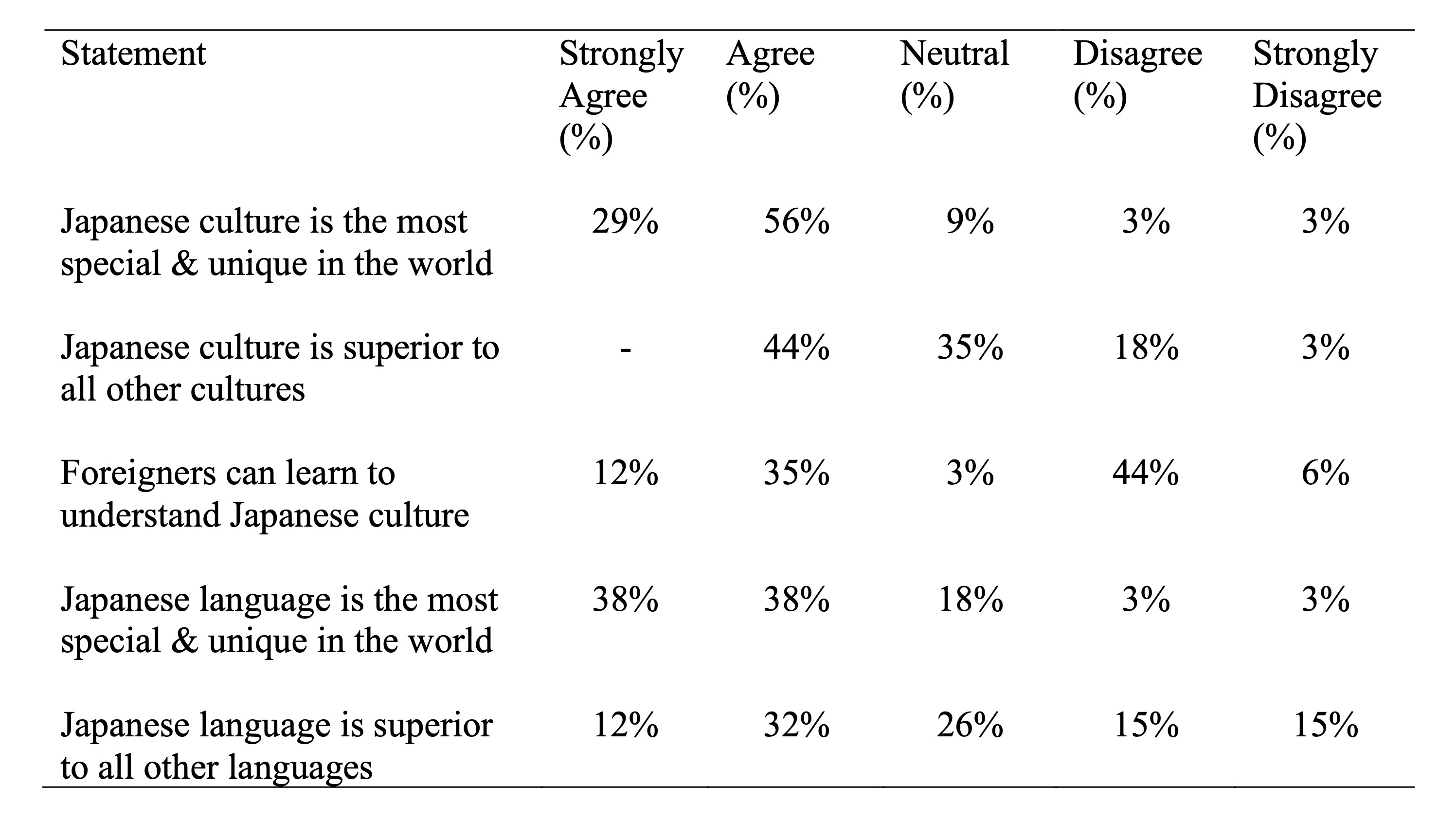
Students showed strong agreement with several key tenets of Nihonjinron, particularly those emphasising Japanese cultural and linguistic uniqueness. As shown in Table 1, on aggregate, 85% of respondents agreed that Japanese culture is the most unique in the world, with 44% considering it superior to all other cultures. Views were evenly spilt regarding foreigners’ ability to learn to understand Japanese culture. 76% of respondents considered Japanese a special and unique language, with 44% believing it superior to all other languages. These responses reflect the persistence of cultural essentialist thinking that reflect core beliefs of Nihonjinron discourse, particularly the view that Japan is culturally and linguistically distinct from the rest of the world.
Table 1
Student Beliefs about Japanese Culture and Language (N = 34)
Beliefs About Race and Identity
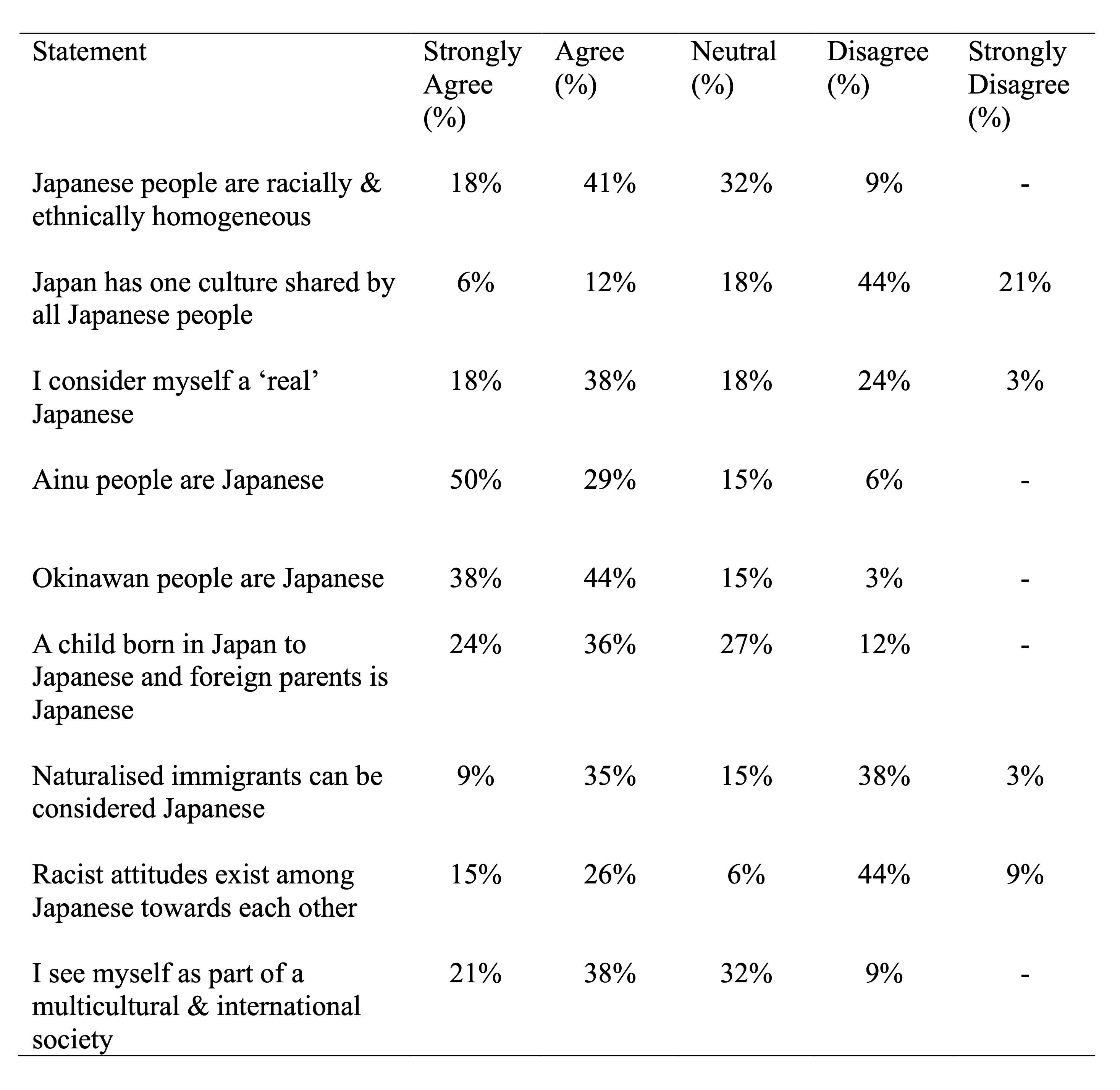
Responses to identity-related items revealed a complex and sometimes contradictory picture (see Table 2). While 59% of students agreed that Japanese people are racially and ethnically homogeneous, 65% disagreed with the idea that Japan has one culture shared by all Japanese people. Almost all respondents affirmed that Ainu and Okinawan individuals are Japanese, and 60% believed that children born in Japan to one Japanese and one non-Japanese parent should be considered Japanese, with only 12% disagreeing. Views on the ‘Japaneseness’ of naturalised immigrants were mixed, though 59% of students agreed they were part of a multicultural society. Interestingly, only 56% of respondents considered themselves ‘real’ Japanese. In open-ended responses, several students linked this uncertainty to discomfort with social conformity and cultural expectations:
“I don't like being the same as everyone else, so I want to go abroad.”
“Japanese people prioritise others, put themselves last, and hesitate to express themselves.”
Participants were divided over the extent that racism exists within Japanese society, though in open-response questions, no respondents explicitly mentioned race, bloodline, or ancestry, indicating that students’ definitions of Japanese identity were more cultural than biological. Instead, responses described being Japanese in terms of manners, modesty, conformity, and social pressure:
“Harmony with others rather than their own opinions and thoughts.”
“People who value tradition.”
“Polite and quiet, with pressure to conform.”
“Think about what others are thinking before acting and concerned about others’ opinions.”
Survey responses suggest that students do not see national identity as fixed or monolithic. Rather, they hold a range of perspectives that reflect both essentialist and post-national views of identity.
Table 2
Student Beliefs about Japanese Identity and Race (N = 34)
Beliefs Regarding Language Learning
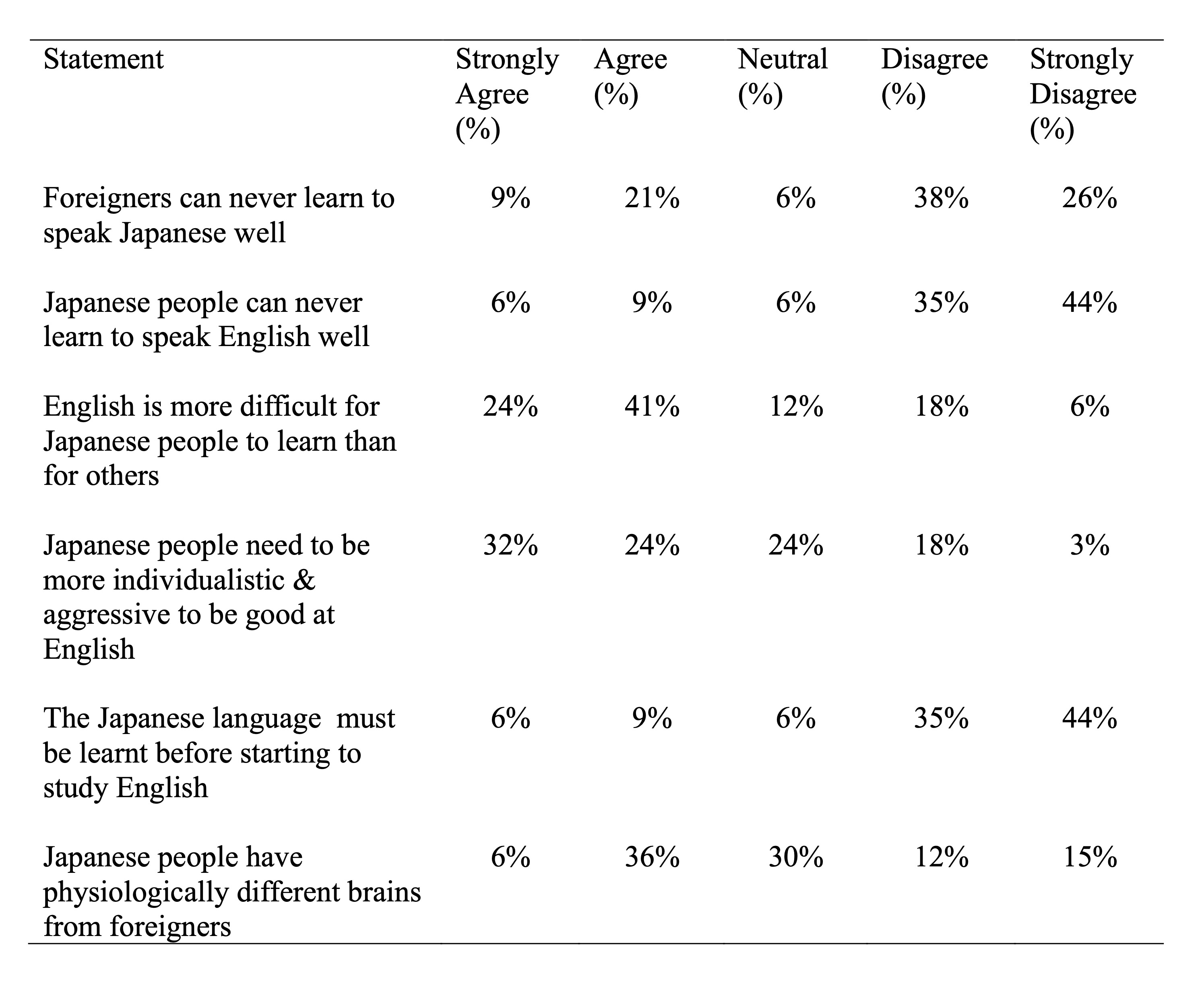
Despite holding culturally essentialist views, students generally rejected the idea that this uniqueness impedes language acquisition. While a significant minority of the students (42%) agreed that Japanese people have physiologically different brains from foreigners—a notion used to justify English learning difficulties in Nihonjinron texts—as Table 3 shows, 79% rejected the claim that Japanese people cannot learn to speak English well, and 64% rejected the notion that foreigners cannot learn Japanese fluently. Only 21% endorsed the Nihonjinron related belief that one must learn the Japanese before learning a foreign language. While 65% of students believed that learning English is especially difficult for Japanese people, open question responses typically attributed this to grammar and pronunciation:
“The grammar is completely opposite, so it’s challenging.”
“Japanese and English pronunciation are completely different, so it often takes time to master the accent.”
“Pronunciation feels difficult.”
56% of the students believed that Japanese people must become more individualistic and aggressive to succeed in English. In open question responses, students did not necessarily see this as negative, reflecting on cultural traits such as shyness, modesty, and meticulousness:
“If Japanese people learn English, I think they will become more direct in their speech and develop a more active personality.”
“Due to the reserved nature of Japanese people, they may not actively approach others, making it harder to improve their English.”
“Taking proactive action and having confidence. Without these, Japanese people cannot speak English because they try to speak perfectly.”
These comments suggest that while some Nihonjinron ideas (e.g., about personality or language difference) may be present, they are not seen as insurmountable barriers.
Table 3
Student Attitudes Toward learning English (N = 34)
Perceptions of Cultural Threat/Openness
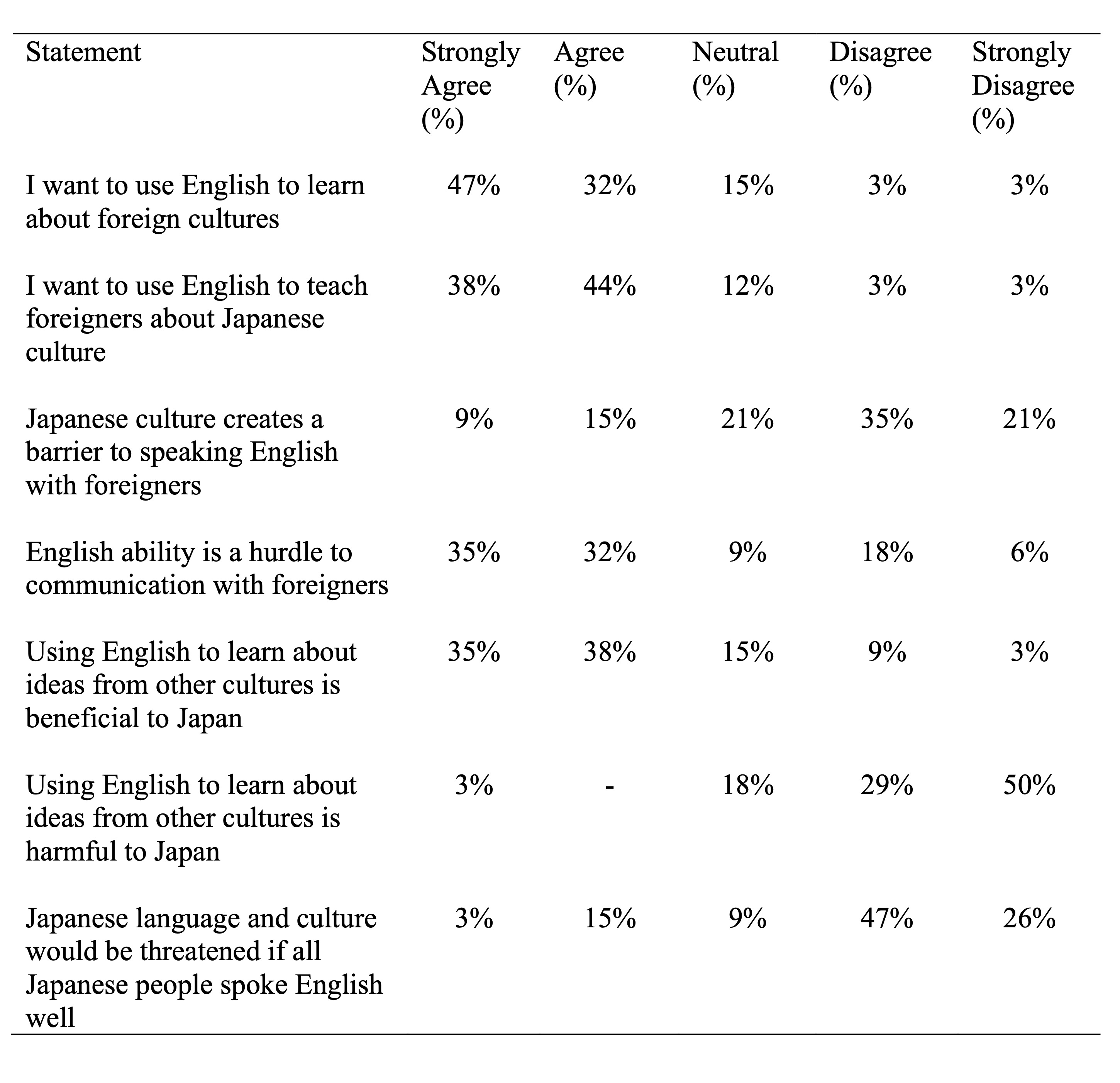
Students’ responses to items related to cultural protectionism and intercultural engagement showed a generally open and outward-looking attitude. As shown in Table 4, a strong majority of students wanted to use English to learn about foreign cultures (79%) and to teach foreigners about Japanese culture (82%). Furthermore, 73% considered using English to learn about ideas from other cultures to be beneficial to Japan, with 79% disagreeing that it could be harmful. 73% disagreed with the idea that Japanese language or culture would be threatened if all Japanese people spoke English well. Open question responses affirmed this tone of curiosity and confidence:
“It gives us the skill to communicate with people from other countries… we can discard our stereotypical thinking.”
“It might be possible to introduce Japanese culture to foreigners using English.”
“English can be a tool for learning about English-speaking cultures.”
While 24% saw Japanese culture as a barrier to speaking English, a much larger portion (67%) cited English ability, not cultural identity, as the main hurdle. These responses suggest that while some cultural narratives may influence perceptions of difficulty, they do not necessarily restrict students’ willingness to engage globally.
Table 4
Student Perceptions of Cultural Threat or Openness (N = 34)
Discussion
The following discussion addresses the research question that guides the current study: To what extent are Japanese high school students’ beliefs about national identity and attitudes towards learning English shaped by the tenets of Nihonjinron discourse? Regarding national identity, the survey results indicate that, to a large extent, students hold strong beliefs concurrent with Nihonjinron discourse regarding the uniqueness and superiority of Japanese language and culture. Views regarding Japanese ethnic and cultural identity were less clear and sometimes contradictory. Despite a majority of respondents believing in Japan’s racial, ethnic, and cultural homogeneity, many stated that prejudicial attitudes existed among Japanese towards each other. In direct contrast to the Nihonjinron literature, students expressed a strong belief in Ainu and Okinawan ‘Japaneseness’, and expressed mixed views on whether half-Japanese and naturalised immigrants could be considered Japanese.
Open question responses stated that cultural behaviours such as cooperation, conformity, subtleness, humility, and putting others before self, were important in defining what it means to be Japanese, with no respondent mentioning ethnicity or race. Student views on Japanese identity and culture, therefore, by no means support the essentialist “fundamental equation between nationality, ethnicity and culture, which privileges the Yamato Japanese as the sole Japanese group” (Liddicoat, 2007a, p. 34) espoused by Nihonjinron, instead aligning more closely with Jin and Cortazzi’s (1998) definition of culture as “socially transmitted patterns of behaviour and interaction” (p. 98). It is possible to suggest that students conceptualise Japanese identity as a matter of shared norms and values rather than immutable racial or national characteristics. This shift away from essentialism supports a more dynamic, inclusive understanding of culture, consistent with poststructuralist perspectives on identity as context-dependent and co-constructed (Darwin & Sun, 2024).
In considering how Japanese high school students’ attitudes towards learning English are shaped by Nihonjinron discourse beliefs, though participants agreed that they had to be more ‘individualistic’ and ‘aggressive’ to speak English well (Hashimoto, 2000), students’ views on learning English did not correlate with the literature on the detrimental effects of Nihonjinron on language learning. The respondents’ belief in Japanese cultural uniqueness was not considered a barrier to communicating in English, a finding at odds with the tenets of Nihonjinron discourse and its effects on language learning, with respondents mainly citing grammatical and phonological issues. The students’ strong assertion that foreigners could learn to speak Japanese well also strongly contrasts Nihonjinron discourse. The students’ emphatic belief that Japanese can learn to speak English well does not correlate to the belief that holding views on national identity consistent with Nihonjinron create barriers to English communicative competence. The survey findings also dispute those of Haugh (1998), who found that Japanese believed they were poor at learning spoken English and dispute the assertion that Nihonjinron leads to a stigmatisation of English among Japanese students (Shah, 2024).
The concerns that Kokusaika, working synergistically with Nihonjinron, negatively impacts language learning were largely dispelled. Sullivan and Schatz’s (2009) findings that Nihonjinron and Kokusaika position English language as having values very different to Japan, was not of concern to students, who viewed the use of English to learn about foreign cultures as beneficial, not harmful, to Japan. The findings indicate the concerns that those in power wish to ‘protect’ Japan from foreign culture (Borg, 2023; LoCastro, 1990; Unoki, 2020), by creating barriers to English communicative competence (Reesor, 2002), to be unfounded or ineffectual. Students’ views opposed the need to develop the Japanese self before learning foreign languages (Hashimoto, 2000). Students’ views were consistent with studies regarding the effects of Nihonjinron and Kokusaika in that that they wanted to express their ‘Japaneseness’ in teaching foreigners about Japanese culture. However, students were equally keen to use English to learn about foreign cultures. This finding does not therefore correlate with views stating that the tenets of Nihonjinron have influenced English language education in being designed for the monodirectional spread of Japanese culture (Suzuki, 1995).
In summation, though many students held beliefs consistent with Nihonjinron, these views did not correlate with any ill-effects that holding such views might have on language learning, or the negative impact that Nihonjinron discourse, and by extension Kokusaika, are argued to have on educational policy. Further, it cannot be said that students internalised the dichotomy that English is incompatible with Japanese identity. A number of factors may account for these findings. Firstly, the participants’ homestay experiences likely provided real world exposure that challenged or reshaped any pre-existing Nihonjinron-related assumptions, highlighting the value of exchange programmes in fostering openness toward intercultural communication. Secondly, regular interaction with foreign language teachers who spoke Japanese, and Japanese English teachers with high English proficiency, may have helped normalise bilingual and bicultural competence, further weakening the perceived gap between ‘Japanese’ and ‘foreign’. Additionally, the lack of familiarity with the term Nihonjinron itself suggests that these discourses may now operate more subtly or diffusely than in past decades. Finally, it must be acknowledged that contemporary classrooms differ significantly from those of 20 years ago, when much of the earlier research was conducted. Today’s students are immersed in a more globalised environment, with greater access to international media, diverse peer groups, and English in everyday life. Together, these factors likely contribute to a more flexible and pragmatic view of both identity and language learning, reflecting what Brooke (2022) describes as an ongoing process of generational reinterpretation, through which Japanese national identity is continuously being reshaped.
Limitations and Further Study
Identity research is always incomplete (Darwin & Sun, 2024). The findings of this paper arguably raise more questions than they answer. Students espoused some Nihonjinron beliefs despite having never heard of Nihonjinron or understanding its meaning. The origin of these beliefs in relation to mass media or parents’ views could provide useful insights. The students in this study are enrolled on an English programme and have experienced a two-month homestay. A follow-up study comparing their responses to the first graders’, yet to go aboard, and the students on the ‘regular’ course, would be useful to investigate how language learners may engage in identity construction and negotiation through speaking (Norton, 1997). As the group of participants were all Japanese nationals with only 2 possessing non-Japanese or mixed parentage, a comparison of views with a more ethnically diverse group of Japanese high school students would provide an interesting comparison, especially given the recent influx of immigrants into Japan. Further, a comparison of views concerning modalities of cultural uniqueness with high schools in different countries would ascertain how ‘uniquely Japanese’ Nihonjinron beliefs are in a global setting. Finally, Nihonjinron may be correct, and I as a foreigner am not qualified to study Japanese students or Nihonjinron.
Conclusion
This paper examined Nihonjinron and associated literature that states its incompatibility with multilingualism and multiculturalism, which are considered essential concepts for language education (Duff & Uchida, 1997). The study investigated the extent to which Japanese high school students’ beliefs about national identity and attitudes towards language learning are shaped by the tenets of Nihonjinron discourse. Overall, It can be stated that despite expressing some beliefs consistent with Nihonjinron discourse, student views on language learning were largely unimpeded by the effects or concerns highlighted in the literature that holding such beliefs might have. The students’ beliefs do not adhere to Hashimoto’s (2000) claim that the goal of English language education in Japan is the ‘Japanisation’ of students by distinguishing ‘us’ from ‘them’. Instead, the findings indicate that students’ views on language learning may align with the notion of ‘transculturation’ (Pratt, 1991) that celebrates cultural variation and differences that provide open-ended possibilities for students in their language studies (Atkinson, 1999).
References
Atkinson, D. (1999). TESOL and culture. TESOL Quarterly, 33(4), 625-654. https://doi.org/10.2307/3587880
Auerbach, E. R., & Burgess, D. (1985). The hidden curriculum of survival ESL. TESOL Quarterly, 27(1), 9-32. https://doi.org/10.2307/3586274
Befu, H. (1987). Ideorogī toshite no Nihonbunkaron [Nihonjinron as ideology]. Shisō no Kagusha.
Benedict, R. (1946). The chrysanthemum and the sword: Patterns of Japanese culture. Houghton Mifflin.
Bouchard, J. (2017). Ideology, agency, and intercultural communicative competence. Springer.
Borg, P. (2023). Has school English language education in Japan been a ‘failure’? The Journal of Gifu Kyoritsu University, 56(2), 127-142. http://hdl.handle.net/11207/2211
Brooke, S. (2022). Constructing national identity: Japanese narratives and triadic discourses. Electronic Journal of Contemporary Japanese Studies, 22(3), Article 9. Retrieved from https://japanesestudies.org.uk/ejcjs/vol22/iss3/brooke.html
Cook, H. M. (2006). Joint construction of folk beliefs by JFL learners and Japanese host families. In M. A. DuFon & E. Churchill (Eds.), Language learning in study abroad contexts (pp. 120–50). Multilingual Matters. https://doi.org/10.2307/jj.27195488.11
Darwin, R., & Sun, T. (2024). Intercultural communication and identity. Cambridge.
Doi, T. (1971). Amae no kōzō [The anatomy of dependence]. Kobundō.
Dornyei, Z. (2003). Questionnaires in second language research. Lawrence Erlbaum.
Duff, P., & Uchida, Y. (1997). The negotiation of teachers’ sociocultural identities and practices in postsecondary EFL classrooms. TESOL Quarterly, 31(3), 451-486. https://doi.org/10.2307/3587834
Hashimoto, K. (2000). ‘Internationalization’ is ‘Japanisation’: Japan’s foreign language education and national identity. Journal of Intercultural Studies, 21(1), 39-51. https://doi.org/10.1080/07256860050000786
Haugh, M. (1998). Native-speaker beliefs about Nihonjinron and Miller’s “law of inverse returns”. The Journal of the Association of Teachers of Japanese, 32(2), 27-58. https://doi.org/10.2307/489578
Hinenoya, K., & Gatbonton, E. (2000). Ethnocentrism, cultural traits, beliefs, and English proficiency: A Japanese sample. The Modern Language Journal, 84(2), 225-240. https://psycnet.apa.org/doi/10.1111/0026-7902.00064
Jin, L., & Cortazzi, M. (1998). The culture the learner brings: A bridge or a barrier? In M. Byram & M. Fleming (Eds.), Language learning in intercultural perspective, approaches through drama and ethnography (pp. 98-118). Cambridge.
Kawai, Y. (2015). Deracialised race, obscured racism: Japaneseness, Western and Japanese concepts of race, and modalities of racism. Japanese Studies, 35(1), 23-47. https://doi.org/10.1080/10371397.2015.1006598
Kinginger, C. (2009). Language learning and study abroad. Palgrave Macmillan.
Kubota, R. (1999). Japanese culture constructed by discourses: Implications for applied linguistics research and ELT. TESOL Quarterly, 33(1), 9-35. https://doi.org/10.2307/3588189
Kubota, R. (2003). Critical teaching of Japanese culture. Japanese Language and Literature, 37(1), 67-87. https://doi.org/10.2307/3594876
Liddicoat, A. J. (2007a). Internationalising Japan: Nihonjinron and the intercultural in Japanese language-in-education policy. Journal of Multicultural Discourses, 2(1), 32-46. https://doi.org/10.2167/md043.0
Liddicoat, A. J. (2007b). The ideology of interculturality in Japanese language-in-education policy. Australian Review of Applied Linguistics,30(2), 20-36. https://doi.org/10.2104/aral0720
LoCastro, V. (1990). The English in Japanese university entrance examinations: a sociocultural analysis. World Englishes, 9(3), 343-354. https://doi.org/10.1111/j.1467-971X.1990.tb00271.x
Manabe, K., & Befu, H. (1993). Japanese cultural identity: An empirical investigation of nihonjinron. Japanstudien, 4(1), 89-102. https://doi.org/10.1080/09386491.1993.11827036
MEXT (The Japanese Ministry of Education, Culture, Sports, Science, and Technology). (2012). On nurturing students as people who are capable of communicating with others successfully in international settings.
Mouer, R., & Sugimoto, Y. (1986). Images of Japanese society: A study in the structure of social reality. Kegan Paul International.
Nakane, C. (1967). Tateshakai no ningen kankei [Japanese Society]. Kōdansha.
Norton, B. (1997). Language, identity, and the ownership of English. TESOL Quarterly, 31(3), 409-429. https://doi.org/10.2307/3587831
Pratt, M. L. (1991). Arts of the contact zone. Profession, 91, 33-40.
Phillipson, R. (1992). Linguistic imperialism. Oxford University Press.
Reesor, M. (2002). The bear and the honeycomb: A history of Japanese English language policy. Journal of Language, Culture and Communication, 4(1), 41–52.
Reesor, M. (2003). Japan’s attitudes to English: Towards an explanation of poor performance. NUCB JLCC, 5(2), 57-65. https://cir.nii.ac.jp/crid/1570009751983680896.csv#:~:text=https%3A//cir.nii.ac.jp/crid/1570009751983680896
Rivers, D. J. (2011). Japanese national identification and English language learning processes. International Journal of Intercultural Relations, 35(1), 111–123. https://doi.org/10.1016/j.ijintrel.2010.09.006
Schleef, E. (2014). Written surveys and questionnaires in sociolinguistics. In J. Holmes & K. Hazen (Eds.), Research methods in sociolinguistics: A practical guide (pp. 42-57). Blackwell.
Schneer, D. (2007). (Inter)nationalism and English textbooks endorsed by the Ministry of Education in Japan. TESOL Quarterly, 41(3), 600-607. https://doi.org/10.1002/j.1545-7249.2007.tb00092.x
Seilhamer, M. P. (2013). Obstacles to Japanese membership in the imagined global community of English users. The Language Teacher, 37(5), 39-43. https://doi.org/10.37546/JALTTLT37.5-11
Shah, A. (2024). Minoritizing identity: imposing racial and cultural illusions of ‘the Japanese’. Japan Forum, 37(1), 112–138. https://doi.org/10.1080/09555803.2024.2419681
Stapleton, P. (2000). Culture’s role in TEFL: An attitude survey in Japan. Language, Culture and Curriculum, 13(3), 291-305. http://dx.doi.org/10.1080/07908310008666605
Sugimoto, Y. (1999). Making sense of Nihonjinron. Thesis Eleven, 57, 81-96. https://doi.org/10.1177/0725513699057000007
Sullivan, N., & Schatz, R. T. (2009). Effects of Japanese national identification on attitudes toward learning English and self-assessed English proficiency. International Journal of Intercultural Relations, 33, 486-497. https://doi.org/10.1016/j.ijintrel.2009.03.001
Suzuki, T. (1995). Can Japanese become an international language? Kodansha.
Vogel, E. F. (1979). Japan as number one. Harvard.
Wierzbicka, A. (1997). Understanding cultures through their key words. Oxford.
Yoshino, K. (1992). Cultural nationalism in contemporary Japan: A sociological enquiry. Routledge.
Unoki, K. (2020, May 22). Ineffective English education as thought control. The Japan Times, Opinion Reader. https://www.japantimes.co.jp/opinion/2020/05/22/reader-mail/ineffective-english-education-thought-control/
Article copyright Dan Walpole.




The electronic journal of contemporary japanese studies was founded on 9 January 2001.
Page created 23 April 2026, last modified 23 April 2026.
Email the webmaster if you have any problems.
Copyright electronic journal of contemporary japanese studies.


