Notes from Rural Japan 4
Volume 26, Issue 1 (Discussion Paper 4 in 2026). First published in ejcjs on 23 April 2026.
Abstract
This is the fourth volume of Notes from Northern Japan. It is my hope that the contents will fit into the multi-disciplinary objective of ejcjs in a manner that is less research than a means of offering news and happenings from rural Japan. I hope that Notes from Northern Japan will both offer themes of interest to those interested in Japan as well as pointing to potential areas of research for researchers.
Keywords: Northern Japan, local news, current events, regional newspapers.
Remembering Earthquakes is Understanding Earthquakes
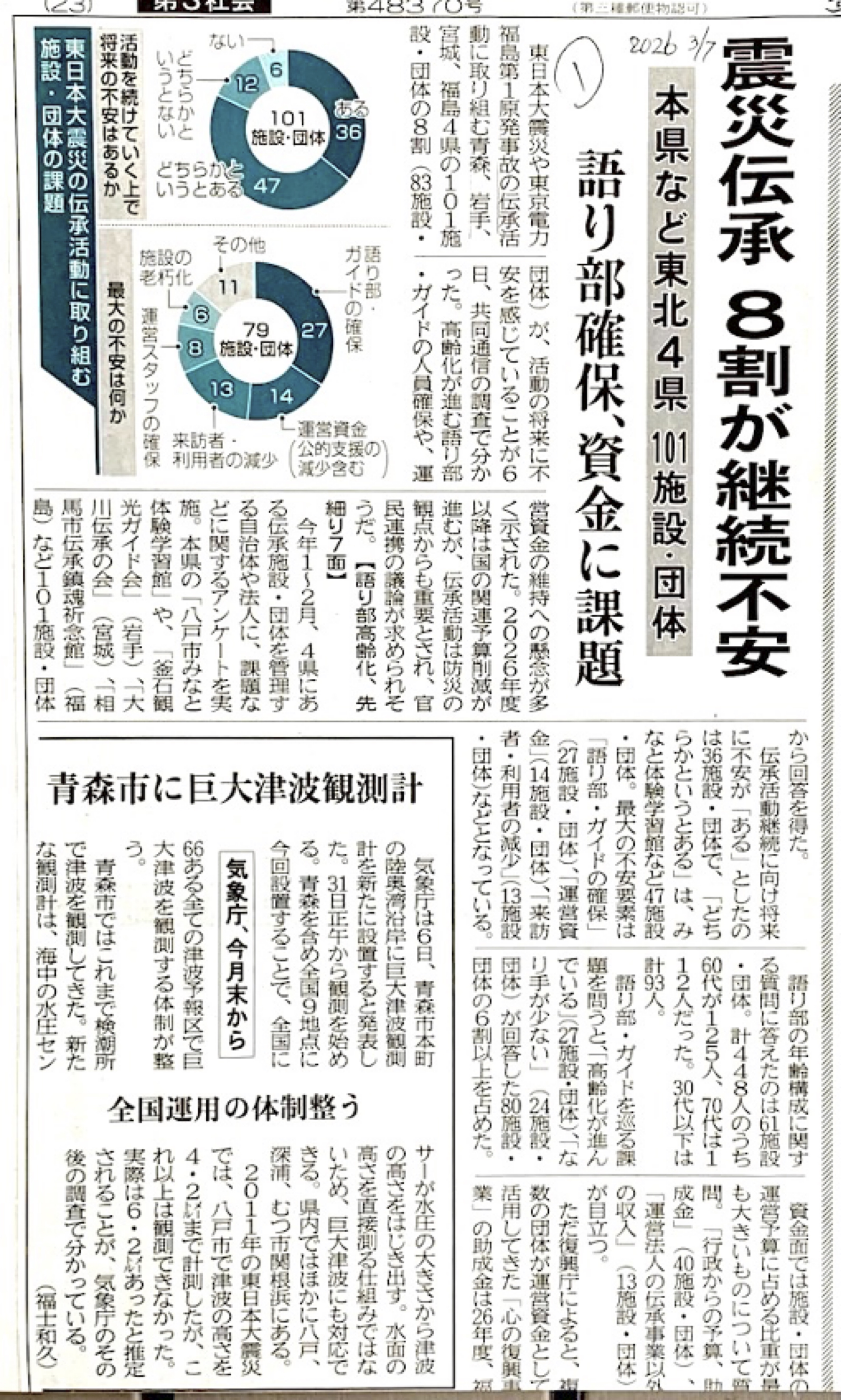
80% Uneasy About Continuity of Earthquake Disaster Knowledge Transmission
Report of 101 Tohoku-based Associations and Facilities
Ensuring Those Who Can Speak, Finance Difficulties
(Tōōnippō, 7 March 2026)
A report based on responses of 101 Tohoku-based public associations and local community facilities points to 80 percent having ‘unease’ about the continuity of communicating earthquake knowledge by those who can speak first-hand about the East Japan Great Disaster and Tohoku Power Fukushima Nuclear Power Reactor Accident.
Specifically, the difficulties now being encountered in these activities were identified as ensuring the continuation of those with first-hand experience about their experience and those who can speak either knowledgeably as guides, as well as the finances needed to maintain sites and facilities. And with further strains on national and local budgets seen for 2026, the concern is both real and rising.
As shown in the data provided in the article, along with the concerns about not having volunteers who can provide experiences of the earthquake, who are decreasing due to aging, there are worrying trends both in the state of earthquake history sites and the associated facilities as well as the fact that the number of visitors is shrinking.
From my own perspective, while information about disaster preparedness and evacuation are provided frequently in community newsletters and at workplaces and schools, one can assume that it is the awareness of the constant – and immediate—possibility of disasters that is equally important. How to ensure this continual awareness is a deceivingly difficult social challenge. Social memory of significant events, while valuable in itself, is very powerful in this regard. Social memory is also a foundation of the shared memory of a time and a place.
The Future of Picking Mountain Vegetables?
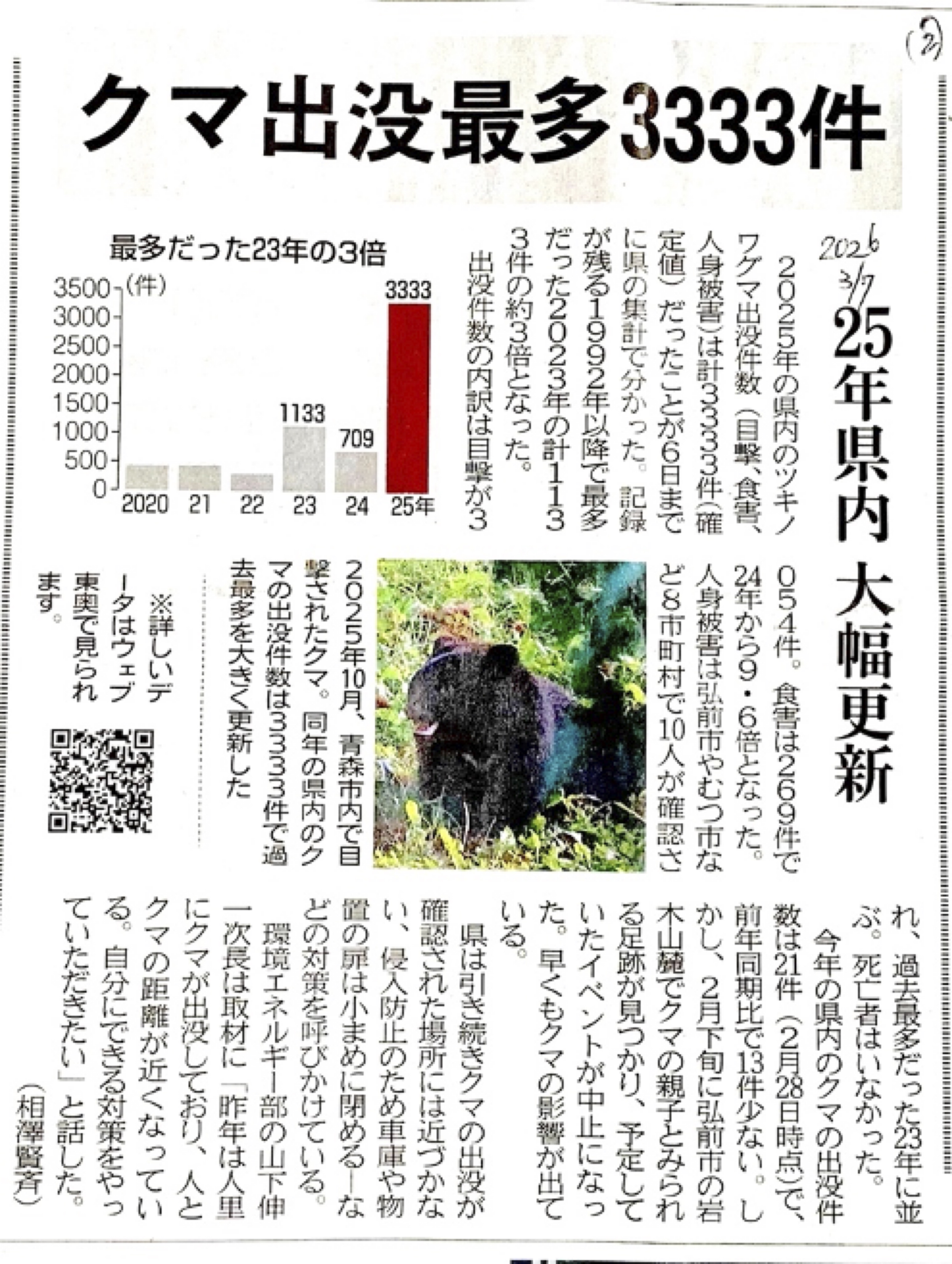
Bear Sightings Largest Ever at 3,333
2025 Prefecture Large Margin Increase Again
(Tōōnippō, 7 March 2026)
2025 saw the largest number of Tsukinowaguma (Asian Black Bear) sightings (defined as sightings, agricultural crop damage, human injury) for the year and the largest increase in Aomori Prefecture history. Recording of bear sighting data began in 1992, with the previous high and largest annual increase occurring in 2023 with 1,113 sightings, an increase from under 500 in previous years. The figure for the 2025 sightings numbered 3,333, a three-time increase over this previous high. Bear sightings accounted for 3,054 of the figure, with 269 cases of agricultural crop damage reported, a 9.6 percent increase, and ten confirmed cases of injury, but no deaths. Spring accounted for the most sightings seasonally, with numerous events cancelled as a result. As the geographic range and specific circumstance of bear sightings has increased, encounters are increasingly difficult to predict, and authorities warn to keep buildings closed securely.
A big part of life in rural Japan is picking mountain vegetables—sansai tori—an important three-season activity for many people. One of the first vegetables of spring is the fuki no tō (butterbur buds), along with warabi (bracken fern) and takenoko (bamboo shoots). Summer brings akaza (goosefoot) and myōga (Japanese ginger). Fall mountain vegetable picking usually focuses on the variety of mushrooms one finds in Japanese forests. Age is taking its toll on the practice of sansai tori, but one can assume that the increasing frequency of bear sightings—and encounters—will have an effect as well.
The Importance of Local Radio
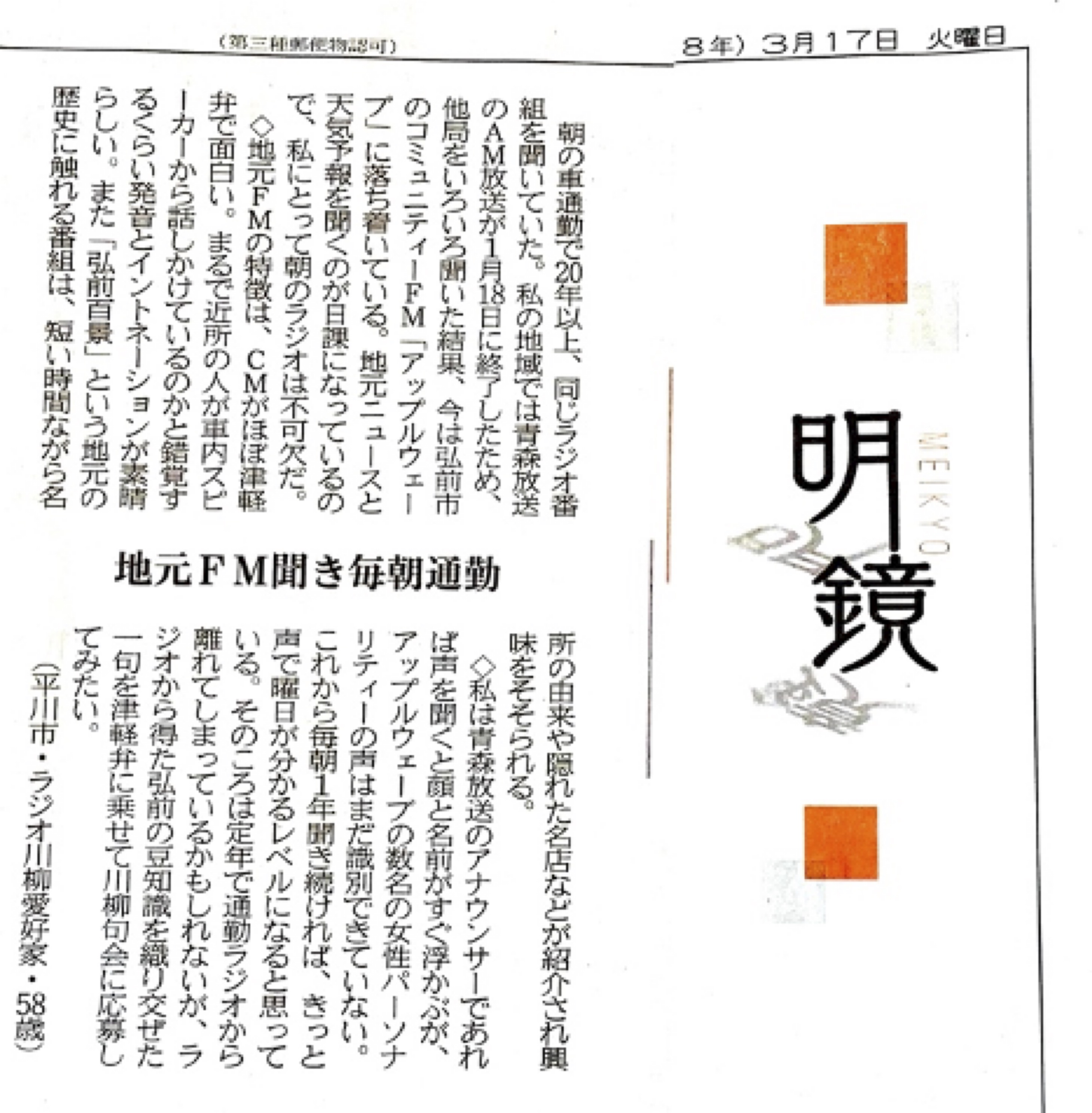
Listening to Local FM Radio on my Every Morning Commute
(from the TōōnippōMeikyō column, 17 March 2026)
Over more than 20 years of commuting to and from work, I have listened to the same local radio station every morning. I have depended on the local news to keep me informed and the weather to help me plan my weekends; and I have always appreciated the added commentary about interesting local events, looking back and looking forward. Local radio is indispensable for me.
Another thing that I really enjoy about listening to local radio is that the announcers and many of the advertisements use the local dialect—Tsugaru ben. As time passes, the use of local dialects is decreasing, so it is reassuring to hear the language that I grew up with on the radio every morning. The accents and intonations feel so familiar.
Of course, it is common for viewers to come to feel familiarity with national television personalities, but with local radio, that familiarity takes on a special closeness. You know that the announcers that you enjoy hearing each morning actually live in the area… they see the same mountains and join the same events. I hope that other people in the area can enjoy—nd will support—local FM radio as well.
Article copyright Anthony S. Rausch




The electronic journal of contemporary japanese studies was founded on 9 January 2001.
Page created 16 December 2019, last modified 16 December 2019.
Email the webmaster if you have any problems.
Copyright electronic journal of contemporary japanese studies.


