Reducing, Reusing, Recycling, and the Circular Economy—Greening our Approach to Teaching
Volume 26, Issue 1 (Discussion Paper 1 in 2026). First published in ejcjs on 23 April 2026.
Abstract
As the threat of environmental problems to our planet has grown so too has the popularity of environmental themes in English language textbooks and classrooms. Nevertheless, more can be done to incorporate environmentally friendly practices into schools, particularly in the area of waste management. This article details four interventions that address the problem of waste management in a Japanese university setting: one, focused textbook giveaways; two, creating a circular economy worksheet; three, creating a game-based lesson; and four, the use of eco-gift bags. While these initiatives alone may not significantly reduce waste at the school, the researcher hopes they will inspire educators to develop their own strategies for waste reduction and to teach effective waste management practices.
Keywords:environmental education; waste management; sustainable practices
Introduction
Don’t Waste the Opportunity to Address the Problem of Waste
I often find that my best research and teaching ideas come from addressing immediate problems. Too often academics engage with big theoretical problems while ignoring the mundane but pressing issues right in front of them. Often, too, the minor/trivial/mundane can become a doorway to larger, worldly problems. This paper was inspired by a simple observation. During breaks between semesters, as colleagues leave for other positions or retire, I frequently observe the significant amount of stuff that needs to be cleared from offices. In one instance, a professor leaving the university threw away no less than twenty-five boxes of materials—old books, worksheets, manuscripts, and electronic devices. In this particular instance, I took on as much of the material as I could and found people who could reuse other materials. However, in the end, a significant portion of it was simply discarded.
As I was observing this, I couldn’t help but wonder about the environmental impact of all this waste. How many teachers were scattered around the world? How many were hoarding materials that would one day be bound for the dumpster?
The vast amount of waste from professors’ offices was in stark contrast to the messages our university was trying to communicate in our classes. Many of us were using Cengage textbooks with materials from National Geographic, such as Reading Explorer Foundations (Chase & Bohlke, 2019) and World English 2 (Chase & Milner, 2015). Thus, as we taught English skills, many of us were also teaching environmental themes. But were we practicing what we were preaching?
Moreover, at the time I was observing this, I was also learning more about the efforts of cities throughout the world to improve waste management practices in order to combat climate change (Acuto & Ghojeh, 2019; Manfredi Sánchez & Seoane Pérez, 2021; Miller, 2023). In particular, I noted how San Francisco was making significant strides in realising a circular economy through its waste management policies (Sangiacomo, 2019). Little did I know at the time that there was a vast literature on environmentally responsible waste management practices at universities (Jakimiuk et al., 2023; Zhang et al., 2011).
My observations, coupled with my research, encouraged me to think about my own institution—a foreign language university in the Japanese countryside. I wanted to address a local problem, though one perhaps somewhat universal to teachers who have inhabited a particular space for long enough—how to recycle, reuse, and responsibly get rid of “stuff.” The specific “stuff” I was most interested in was (1) old worksheets, (2) old textbooks, and (3) materials from past events. The problem—if it can be described as such—is how to reuse, reduce, and recycle materials in ways that could help students. I also wanted to communicate the lessons of the circular economy to my students in more elegant and interactive ways. Though I knew I would never be an expert on waste management, perhaps there were some small interventions I could develop that would be both practical and educational.
Reviewing the Literature; or, On the Fine Art of Not Wasting Scholarly Energy
To solve this problem, I began by consulting the scholarly literature. Following the example of scholar Ken Booth (2007, p. 39-40), my approach was that of pearl-fishing—looking for useful ideas in the scholarly literature that could be repurposed into immediate actions at my school.
My search led me to several interesting studies that explored the intersections of education and waste management. A study by Tiippana-Usvasal et al. (2023) makes the case for teaching aspects of the “circular economy” at all levels of education through a bottom-up approach. In particular, the article highlights Finland as an exemplary model for teacher-led, grassroots approaches to curriculum development. An article by Xu et al. (2016) that investigates textbook recycling and reusing on campus had many good ideas but was far too technical (and systematic) for what I was hoping to accomplish. I did not want so much to fix a systemic problem of waste—something that was beyond my role at the university; rather, I was hoping to generate some good ideas for decluttering and reusing old resources that I could share with colleagues.
A bachelor’s thesis by Kroupová (2017) examines how to design activities around waste management and recycling for lower secondary schools in the Czech Republic. This project motivated me to consider creating my own mini-lesson on waste management, using a combination of activities and skills. In a similar vein, Nkwetisama (2011), in his article examining methods of teaching environmental English in Cameroon, suggests using task-based learning with meaningful activities rooted in the local community. In particular, Nkwetisama (2011) advocates for “Authentic tasks… that require the learners to use the target language in a way that simulates its use in the real world or real life outside the language classroom” (p. 115).
Perhaps the most useful idea from the academic literature came from Whalen et al. (2018), who used the board game In the Loop to inspire creative thinking about the circular economy. Given that game-based learning is a major research interest to colleagues at my institution, I decided to use the In the Loop game as inspiration for designing my own game session.
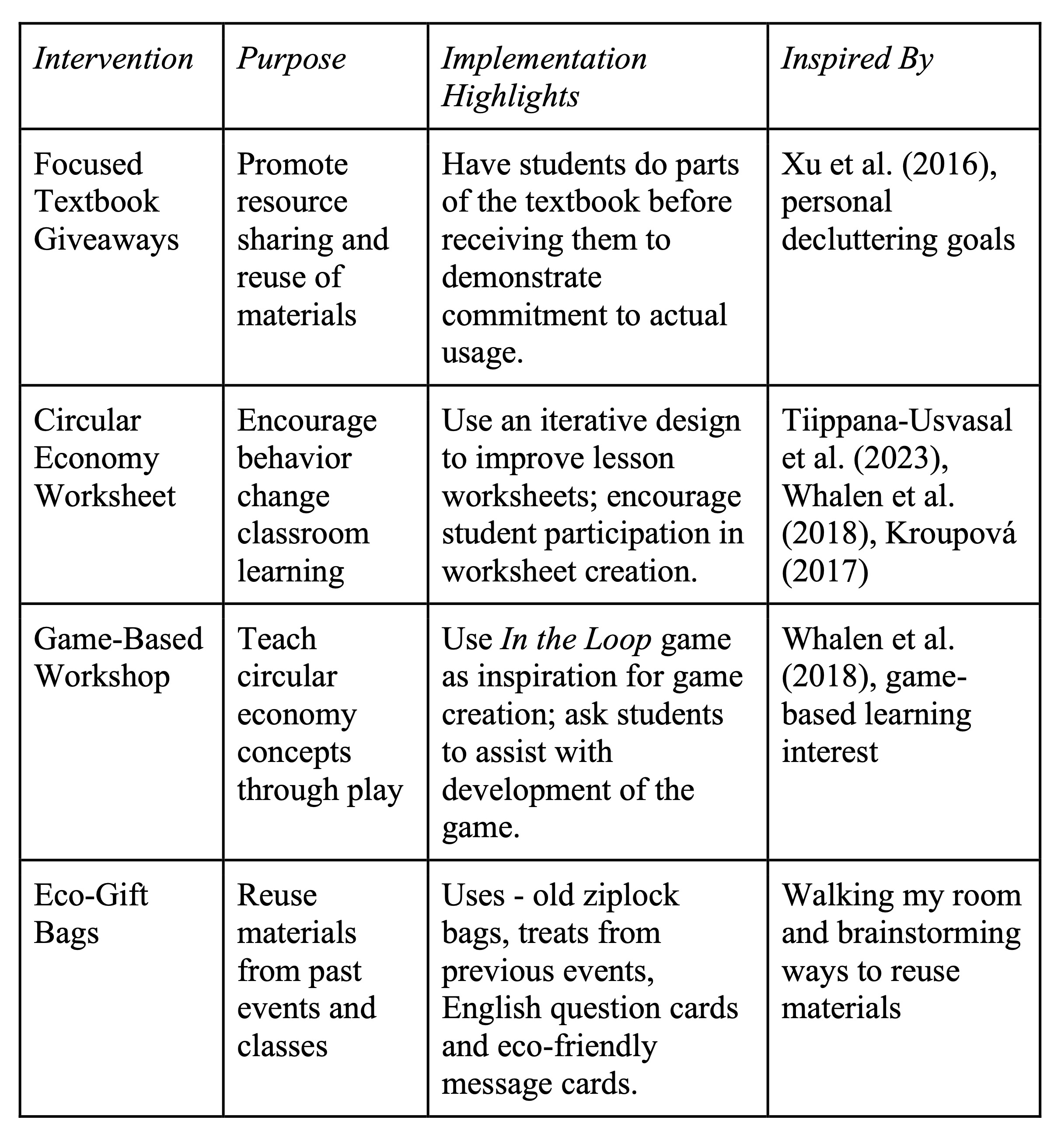
As a result of my reading and the subsequent brainstorming it inspired, I crafted several interventions.
Intervention 1—Focused Textbook Giveaways
During the spring semester of 2025, I engaged in the first intervention: focused textbook giveaways. These textbooks had come to me in a variety of ways. Some I had inherited from previous teachers and students. Some of the textbooks had been sent to me by publishers as samples. While others had simply “found me” somehow. I did not have a lot of textbooks to give away, as I usually avoid ordering unnecessary books. However, I decided to take a very strict approach. If I had not used any resources from a textbook for more than a year, then it was a candidate for giving away to a student.
During class, I would casually ask students whther they were interested in a free textbook. I explained the benefits of studying textbooks a little bit above or below their level and explained that I would gladly give away textbooks if they could demonstrate they would actually use the textbook by doing a few exercises in my office. In total I gave away 22 textbooks to students, who mostly seemed delighted to receive them. Additionally, a folder of old handouts was passed on to a student who was teaching English as a part-time job.
Intervention 2—Circular Economy Worksheet
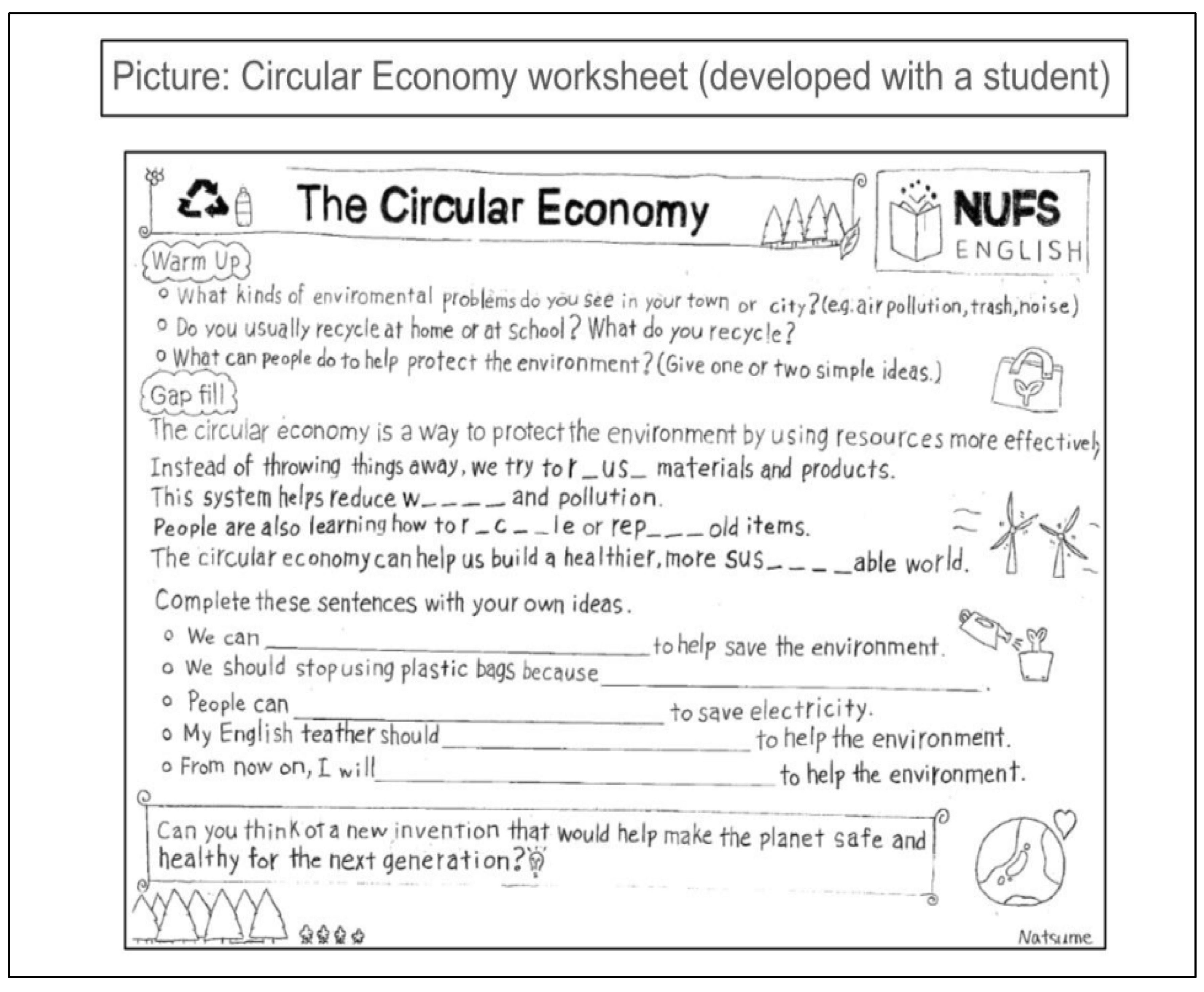
My next intervention was to design a worksheet on the topic of the circular economy. For this task, I enlisted the help of a student in one of my classes with artistic sensibilities. I created the content for the worksheet while she drew the worksheet using pencil and pen. The reason for avoiding using a computer was to give the worksheet an organic, “earthy” design. The lesson was tried out with two students at a local language school at the intermediate level (CEFR B1-B2) and two classes of communication students at a university at the upper beginner level (CEFR A2). Both groups of students seem to benefit from the worksheet and appreciate the environmental themes. Though the upper beginner-level students found the worksheet difficult, they appeared to enjoy the challenge.
Intervention 3—Game-Based Micro-Workshop
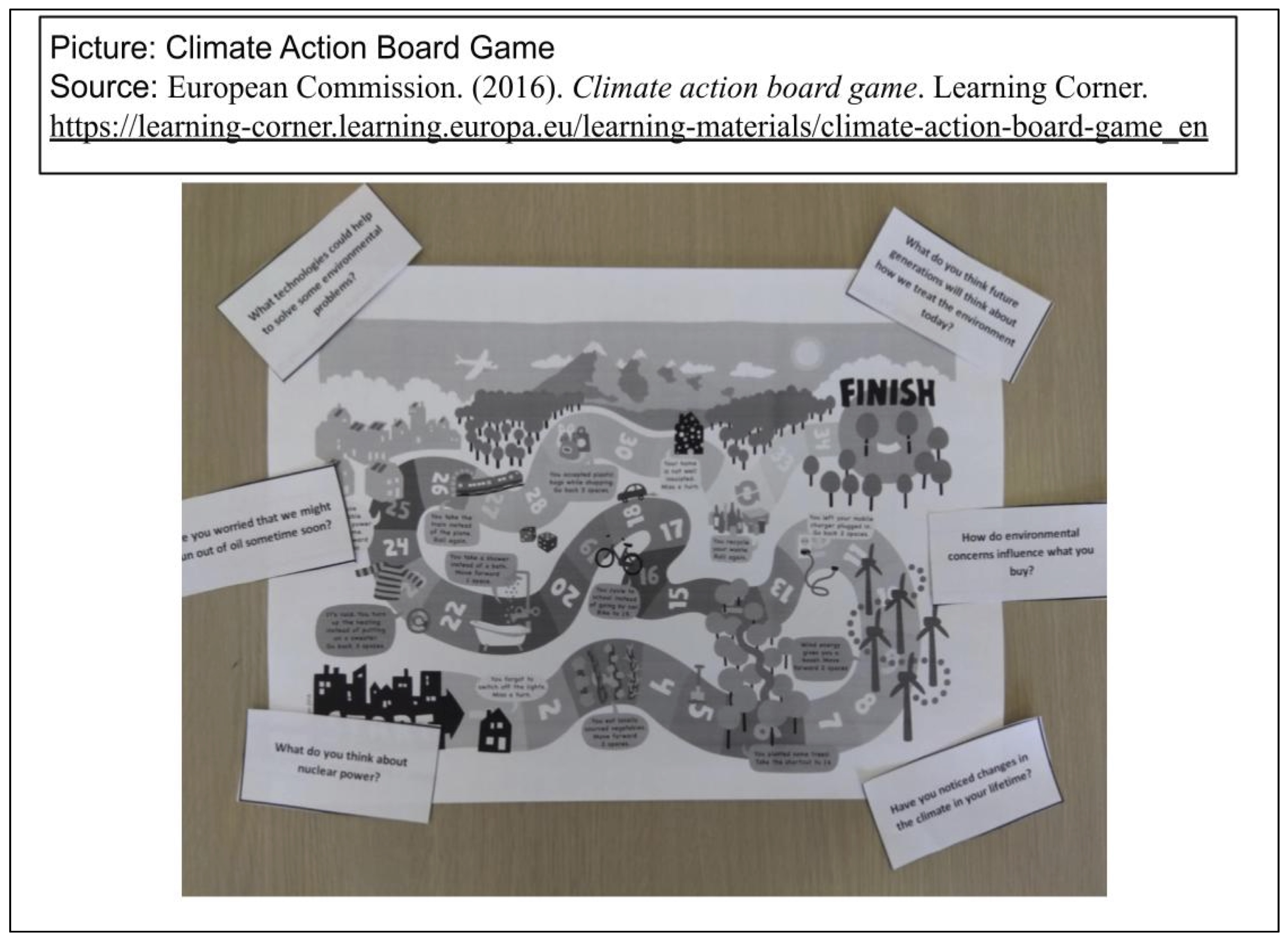
The use of games for educational and especially language learning is well represented in the academic literature (see Brooks, 2023; Lee & Hammer, 2011; Plass, Homer, & Kinzer, 2015). The specific inspiration for the use of game-based learning for this intervention came from a game developed by Whalen et al. (2018). The game encourages players to find environmentally sustainable ways to produce various products. However, because the game was developed with engineering students in mind, I decided to develop a simpler game that would take less time and could be used with learners at the upper-beginner to upper-intermediate level (CEFR A2 - B2). For this reason, I chose a game board developed by the European Commission (2016) to play with students. This resource was supplemented with environmentally themed question cards that were developed with students.
The first iteration of the game was played with a group of three students at a local language school. Even though the students were a mix of levels, the students reported the game as being both fun and educational. In future iterations of the game, I will mix additional game cards that relate directly to the target language from the students’ regular lessons along with the environmentally themed cards.
Intervention 4—Eco-Gift Bags
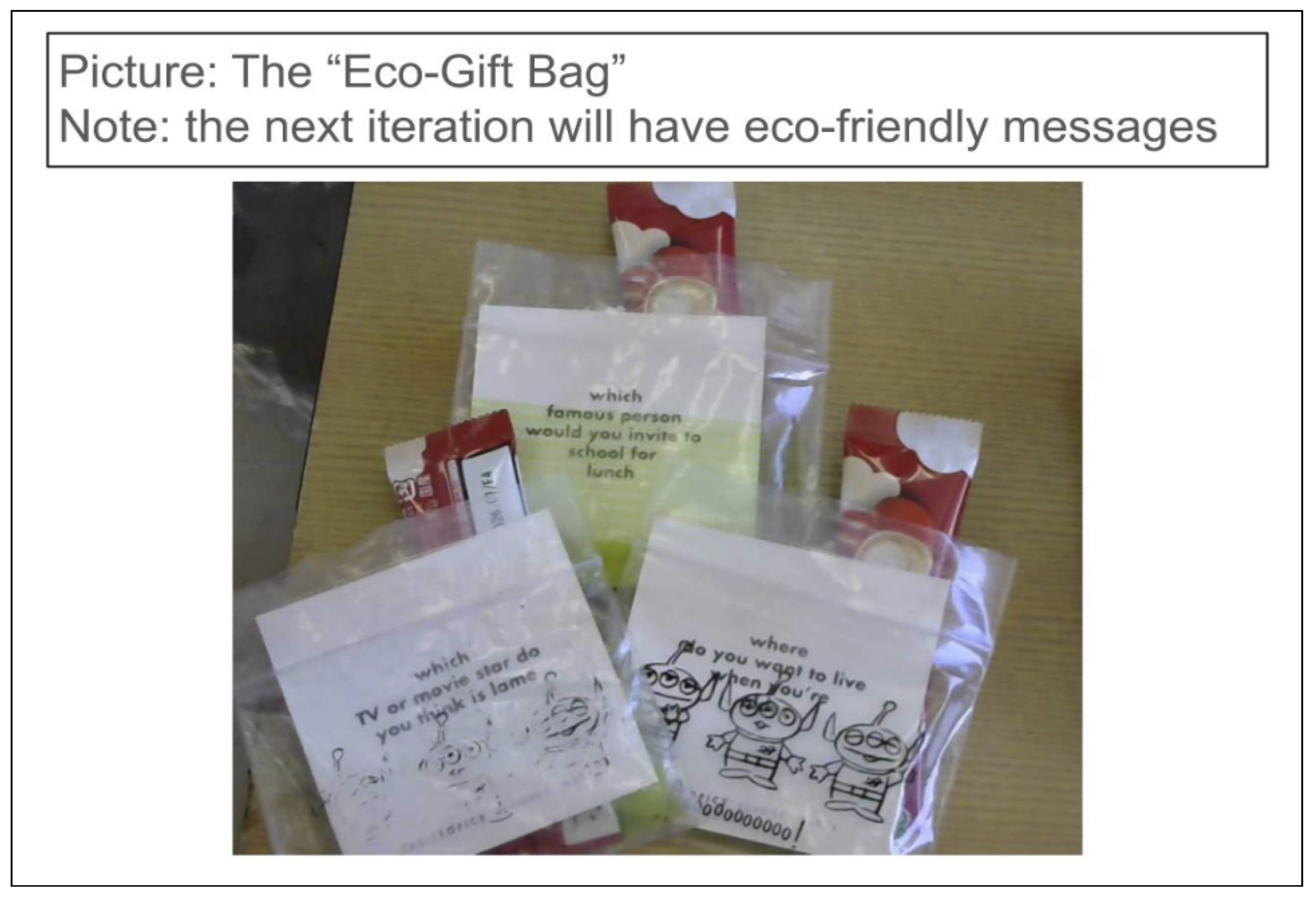
While cleaning my office and sorting through old materials, I thought of a new way to repurpose items I no longer needed. I gathered some old gift ziplock bags, some candies and latte pouches from a past event, and a stack of conversational topic cards that I had been using with students. From these various materials, the “Eco-Gift Bag” was born. The initial version of this idea involved giving the bags filled with the old materials to students as a reward for their hard work. However, I soon realised that I could write eco-friendly messages and environmental tips on little cards and include them in the bags as well. This activity encouraged me to be mindful of ways I could repurpose and use old materials rather than let them linger in my office or become waste.
Conclusion—Less Clutter, Less Waste, More Focus…A Greener Future?
Rather than give into hopelessness, despair, and apathy, in my own small domain of the classroom, I tried to focus on the things I could control. Though these interventions were small, their benefits were various: building student awareness, reusing materials, and creating meaningful building blocks for environmental literacy. I also hope that my small interventions will inspire colleagues to be more thoughtful regarding how they use their resources. Only time will tell if my actions had an impact. Nevertheless, I would encourage all educators to think of small ways to promote their own passions in the classroom, even when there may not be a direct path between the course content and the passion being pursued.
Works Cited
Acuto, M., & Ghojeh, M. (2019). C40 Cities inside out. Global Policy, 10(4), 709-711.
Booth, K. (2007). Theory of World Security. Cambridge: Cambridge University Press.
Brooks, M. (2023). An Investigation of EFL learner’s communicative actions when playing TRPGs online. The Journal of Nagasaki University of Foreign Studies, 26, 79-101.
Chase, B.T., & Milner, M. (2015). World English 2. Heinle & Heinle Publishing.
Chase, B.T., & Bohlke, D. (2019). Reading Explorer Foundations. Heinle & Heinle Publishing.
European Commission. (2016). Climate action board game. Learning Corner.
https://learning-corner.learning.europa.eu/learning-materials/climate-action-board-game_en
Jakimiuk, A., Matsui, Y., Podlasek, A., Koda, E., Goli, V. S. N. S., Voběrková, S., Singh, D. N., & Vaverková, M. D. (2023). Closing the loop: A case study on pathways for promoting sustainable waste management on university campuses. Science of The Total Environment, 892, 164349.
Kroupová, V. (2017). Sustainable waste management at universities: A case study [Bachelor’s thesis, Masaryk University]. Masaryk University Information System.
Lee, J. J., & Hammer, J. (2011). Gamification in education: What, how, why bother? Academic Exchange Quarterly, 15, 146–151.
Manfredi Sánchez, J.L. & Seoane Pérez F. (2021) Climate change begins at home: City diplomacy in the age of the anthropocene. In: Surowiec P, Manor I (eds) Public Diplomacy and the Politics of Uncertainty. Cham: Palgrave Macmillan, 57–81.
Miller, D. (2023). Solved: How the World’s Great Cities are Fixing the Climate Crisis. University of Toronto Press.
Nkwetisama, C. M. (2011). EFL/ESL and Environmental Education: Towards an Eco-Applied Linguistic Awareness in Cameroon. World Journal of Education, 1(1), 110-118.
Plass, J. L., Homer, B. D., & Kinzer, C. K. (2015). Foundations of game-based learning. Educational Psychologist, 50(4), 258– 283.
Sangiacomo, M. J. (2019). Achieving Zero Waste in San Francisco: Successes and Challenges. Journal of International Affairs, 73(1), 285–290.
Tiippana-Usvasalo, M., Pajunen, N., & Maria, H. (2023). The role of education in promoting circular economy. International Journal of Sustainable Engineering, 16(1), 92-103.
Xu, X., Zhu, Y., Liu, H., & Liu, M. (2016, July). Research on the Recycling Strategy of Used Textbooks in Colleges and Universities. In 2016 2nd International Conference on Social Science and Higher Education (pp. 437-441). Atlantis Press.
Whalen, K. A., Berlin, C., Ekberg, J., Barletta, I., & Hammersberg, P. (2018). ‘All they do is win’: Lessons learned from use of a serious game for Circular Economy education. Resources, Conservation and Recycling, 135, 335-345.
Zhang, N., Williams, I. D., Kemp, S., & Smith, N. F. (2011). Greening academia: Developing sustainable waste management at Higher Education Institutions. Waste management, 31(7), 1606-1616.
Article copyright Daniel Clausen.




The electronic journal of contemporary japanese studies was founded on 9 January 2001.
Page created 23 April 2026, last modified 23 April 2026.
Email the webmaster if you have any problems.
Copyright electronic journal of contemporary japanese studies.


